
It's NOT the end of the world

The naughty professor is back and he's pouring cold water on the climate panic.

It's NOT the end of the world

The naughty professor is back and he's pouring cold water on the climate panic.


TRANSCRIPT: 

(This transcript is derived from an automated process.  The video recording is authoritative.)  


Professor Ian Plimer;

Well folks, thanks for coming out. That was a pretty disturbing talk and you have to ask, well, how did we get here? Because we once had a cheap, reliable electricity system. It was based on coal and we had a grid system, and it worked. And it worked for a very long period of time. And it first started when we were told about emissions and how these emissions were dangerous, and these emissions were pollutants. They didn't tell us that the main emission carbon dioxide was actually plant food. We were not told that the main greenhouse gas was actually water vapour. It's not carbon dioxide at all, but of course you can't ban water vapour, you can't have legislation against it. So the whole house of cards is built on something which is a fallacy. And this had been annoying me for quite a while because as a geologist, we look at rock out crops and we ask ourselves questions.

What was the climate like when this sediment was deposited? Was it glacial? Was it tropical? What was the life doing? Then? Where were we? Were we close to a pole? Were we close to an equator? Had the continents moved? And we look at a rock, say like a limestone, which we can pick from vegetation, and we can look at the rock, and that limestone has 44% gas in it, and that gas is carbon dioxide. Yet we are told that that is a pollutant. Or we look at another carbonate rock dolomite, which has got 48% carbon dioxide in it. So as a geologist, we're saying, well, this doesn't sound right. And then when we look back in time for 80% of time, we have not had ice on planet Earth. Ice is quite a rare rock, and we've had ice ages, we've had eight major ice age, and we can back calculate as to how much carbon dioxide was in the atmosphere.

In the past, every one of these eight ice age had more carbon dioxide in the atmosphere than now. So how can we have carbon dioxide driving global warming? How can we have carbon dioxide giving us a climate catastrophe when we see in the past where we've had ice at the equator at sea level, yet we had 20% carbon dioxide in the atmosphere compared with 0.04%. And this really started to annoy me. And I spent five years reading everything I could read, putting together all of the scientific literature, basically saying, look, what you are being told is not correct. There is no such thing as settled science. And there are thousands of references in the scientific literature showing that that's incorrect. And this book has about three and a half thousand references in it. And I just went through the literature, read it all, and showed that everything you are being told is incorrect.

That carbon dioxide is plant food. The main greenhouse gas is water vapour. That carbon dioxide in the past has been up to 20% in the atmosphere over the last 500 million years. It's been decreasing from 0.7% to 0.04%. And if you want the really bad news, we do have a problem with carbon dioxide. There's just not enough of it. And we have had certain plants develop because there's not enough carbon dioxide in the atmosphere. One of those is corn. We had an original atmosphere, rich in hydrogen and helium. The second atmosphere for most of time was rich in carbon dioxide. Our atmosphere now is rich in oxygen, and we are finding that there has been a massive decrease in carbon dioxide and that is giving us a crisis of life, a crisis of plant life. And without plants, we have no animals. So I've listened to what we're being told.
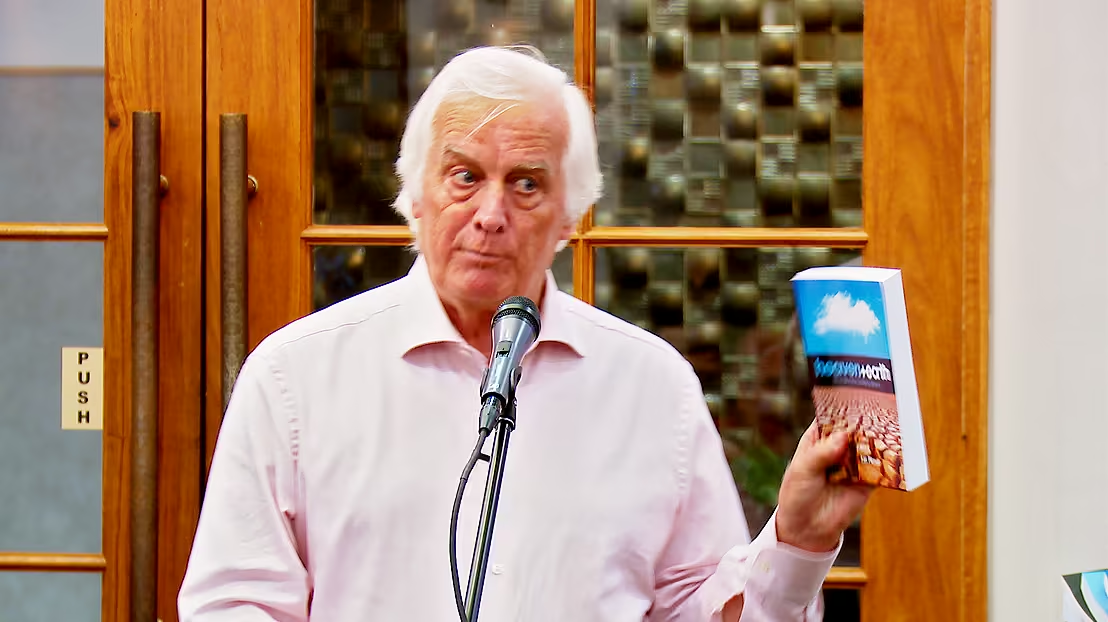
Everything we were being told was absolutely demonstrably scientifically wrong. And so I wrote this book, Heaven and Earth, and I'd written a couple of books before that. So I took these to my regular publishers and they told me to go away. And there was only one publisher that would take it, and it was recommended to me by a chap in Melbourne said, why don't you try this very small publisher called court? And I gave the book to Anthony, and within a couple of days he said, right, we're going to do this. We're going to print the book. We didn't sign a contract for the book until I think been actually printed before we signed a contract. It was an international success. This was a bestseller worldwide. It came out at a very good time. And this was dealing with everything that we hear about, looking at history, looking at archaeology, looking at geology, looking at mediaeval times when it was much warmer, looking at Viking times when it was cold or looking at Roman times when it was warmer.

And it's very clear that there are cycles of climate, and these cycles are based on where the continents are or what's happening out in the cosmos. These cycles are based on what's happening in the ocean, how close we are to the sun, how much energy the sun's putting out. But the two drivers of climate we see over time the energy that the sun puts out and the distance from the sun. Never in the past have we seen a climate change due to carbon dioxide, never. Carbon dioxide has always been in our atmosphere. It's in the atmosphere of other planets. So what we have is a foundation, which is a house of cars. And over the last 20 years, I've been asking various scientists, especially places like the Scott Polar Institute in Cambridge University, just give me half a dozen scientific papers that demonstrate that human emissions of carbon dioxide drive global warming.

They haven't done it. They haven't been able to do it because no such papers exist. So the whole concept of human driven global warming is a fallacy. Now, perish the thought. What happens if I'm wrong? Well, 3% of all emissions are from humans. The rest are natural. So if you can show that 3% of emissions drive warming, you then have to show that the 97% of natural emissions don't. And that's never been done. So what we just heard is mass scale environmental destruction based on a fallacy. Now, this book is a dense book. It was written to show that there's a huge body of science saying that the popular ideas we have are demonstrably wrong, they just don't exist. There's nothing in the literature. You can search and search and search, and you will not find any landmark scientific papers showing that human emissions drive warming.

And that's of course why we want to close our coal fired power stations and have restrictions on you driving a car or using gas for cooking. And on we go. But this book was dense and I thought, well, maybe I should write something that younger people can use and they can ask their teachers about global warming.
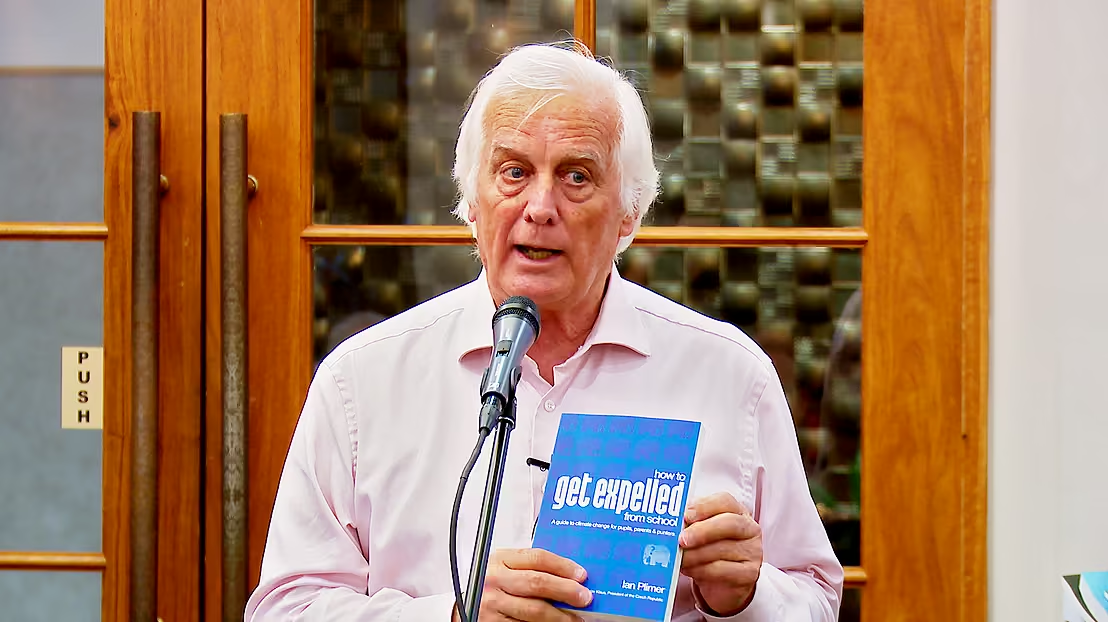
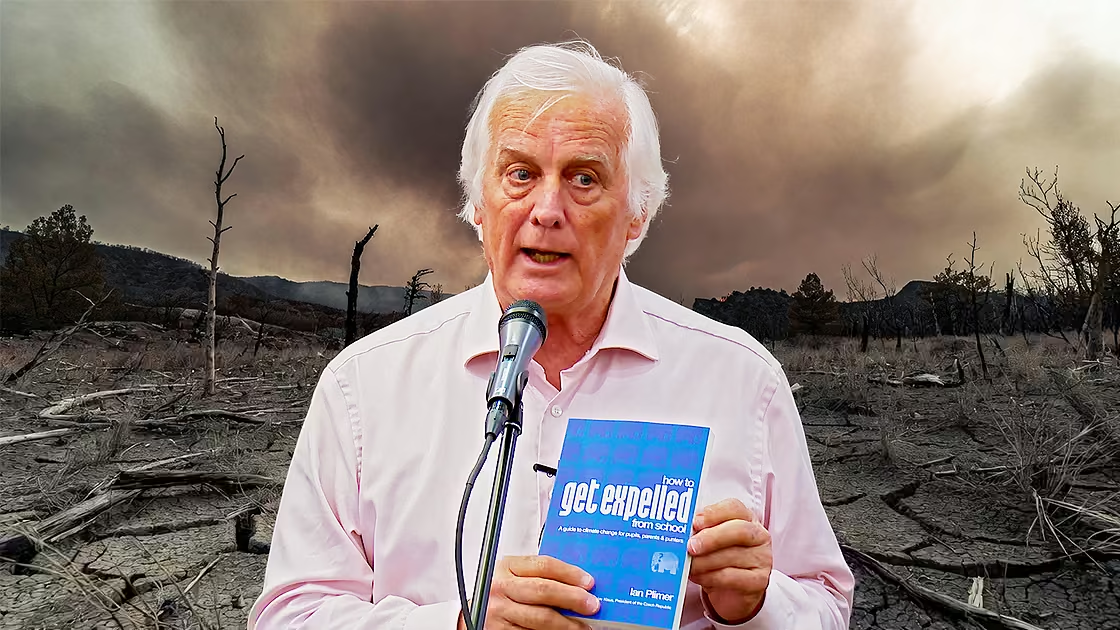
And so this book I put out a bit late, it was called How to Get Expelled from School. And there's 101 questions that the kids can Ask their teachers. And I had the president of the Czech Republic, Dr. Cloth Klaus. He wrote the Forward to it. This was launched by John Howard in Sydney. Oh, did the ABC get into a foam on that one. Anyway, this has got 101 questions that you can ask your teachers. And these questions were deliberately designed. It took a while to get them such that if he said yes, you were wrong.

And if he said no, you were wrong. And I had a special set of questions for Friday afternoon. So if you wanted to get turfed out of school on Friday, I gave you the questions. Now this got up the nose of all of those unemployable people who work in climate institutes. These are people who have failed mathematicians. They work in our climate institutes. They using your money to send you broke and to send up your electricity bills. And under the Gillard government and then the Rudd government, the Gillard government put up a special website using your money. It only cost half a million to try to answer my 101 questions. They couldn't answer them where they couldn't answer 'em, they attacked me. And as soon as Tony Abbott came in as Prime Minister, that website disappeared. So this was a deliberately seditious book giving information that school children could understand, such that they could understand the question they were asking was a valid question, and that that question would nail their teacher.

As an activist, I'm not very popular amongst skilled teachers, and it's not an area of the world that I want to be popular in any way. But I'm also concerned as a geologist, geologists actually go out and there's a couple here who actually go out and look for metals. And we use those metals, we use those metals in our everyday life. And the more civilised the society becomes, the more metals we use and the diversity of metals we use. So if you have a mobile phone, you use 82 of the 92 elements in the periodic table. You cannot get by without using metals. And I thought, well, I might combine metals with energy. And I put out a book not for grains, and it's a book about a teaspoon. How do you make a teaspoon? And I went looking at the history of spoons, how we originally had wooden spoons and bacteria hid in the paws and you'd poison yourself.

And if you're very wealthy, you might be able to have a pewter spoon. If you're even wealthier, you might have a silver spoon. And how in former times people used to travel with a spoon, that was their principle asset and that was their way of stopping dying from poisonous foods. And I went and looked at the modern stainless steel spoon, which has got iron, chromium, nickel in it, sometimes a little bit of molybdenum and tin. So how do you make that spoon? Well, you need any norms, amount of coal, and you need international transport. All the things that the left doesn't like international trade coal. And if you are going to feed yourself and not poison yourself, then you have to have mining of coal, mining of iron mining of chromium in places like South Africa, mining of nickel in places like Indonesia and have national trade such that you've got yourself a spoon to eat with. And what happens when that spoon breaks? Well, you turf it out, you don't recycle it. So this book was trying to show how important energy is to live in the modern world and how you must have large amounts of cheap energy to survive in today's world.

And cheap energy became something of an obsession with me. And I put out another book called Climate Change Delusion and the Great Electricity Ripoff. And we heard a little bit about this, the ripoff of wind, the ripoff of solar. And now of course hydrogen. I mean we tried hydrogen in the 1850s. It failed. We tried in the 18, the 1920s and 1930s it failed. And you can see now some of the hydrogen schemes are starting to fail. Now. God help Gladstone if it ever gets up because the reason I got interested in science was I used to make hydrogen. And hydrogen is a wonderful explosive. You can take out neighbor's windows from a 200 yards away. It is a terrific explosive, and we cannot mine hydrogen. We have to make hydrogen. And if you make hydrogen, you actually use energy to make it and to use, it's an energy loss process.

So here we've got an inefficient process of making energy to make an inefficient product called hydrogen. And then we've got to store it. And the best way to store it is to compress it. So you've only got to compress it 700 times air pressure. You've only got to use enough energy to bring it down to minus 253 degrees Celsius. Of course, easy, but hydrogen actually moves as a gas through solid metal and it weakens that metal. So you store hydrogen in a cylinder, you're going to lose 1% of it per day, plus you've got a beautiful explosion waiting to happen. So in this book I go into why these energy systems such as solar will not work, wind will not work. For example, wind turbine blades are made of balsa wood. So we have to clear some of the Amazonian forests for that balsa. It is inter layered with various epoxies.

One of them is a chemical called bisphenol A that is banned worldwide. It's highly toxic. This is why we can't recycle turbine blades. We just cut them up and leave them in the soil to have the bisphenol a leached into our waterways and soils. You can't recycle it. And the blades are braid. And this best phenol A spreads right across the land in our solar factories. We have cadmium, lead, selenium and tellurium as alloys in those solar panels. And that leaches into the soils and that stays there. So even if your solar factory on prime agricultural land is abandoned, you've still destroyed that land for farming. So I go into some of the wonderful situations that we put ourselves in by claiming that carbon dioxide is a pollutant. Oh, we've got to stop putting the gas of life into the air and kill off all these cheap, reliable, efficient coal fired power stations and go some other direction.

And what we've done is we've opened the doors for the white shoe brigade. They have come in and they're skinning us alive financially, which is why your power prices are going up. So that was the next evolution of my ideas on this. I happened to be locked away for almost a year in a hospital. And what you do in a hospital, you moan and groan. You can't get a drink, so you've got to do something. So I thought I'd write a book and I called that one Green Murder, gentle, non provocative. And basically I look in that book as to how well off we are, what has happened over the last hundred years. Now, 200 years ago, the average longevity was 37 years. We are living longer, we have better health, we have more wealth, we have fewer wars. Everything in today's world is better.
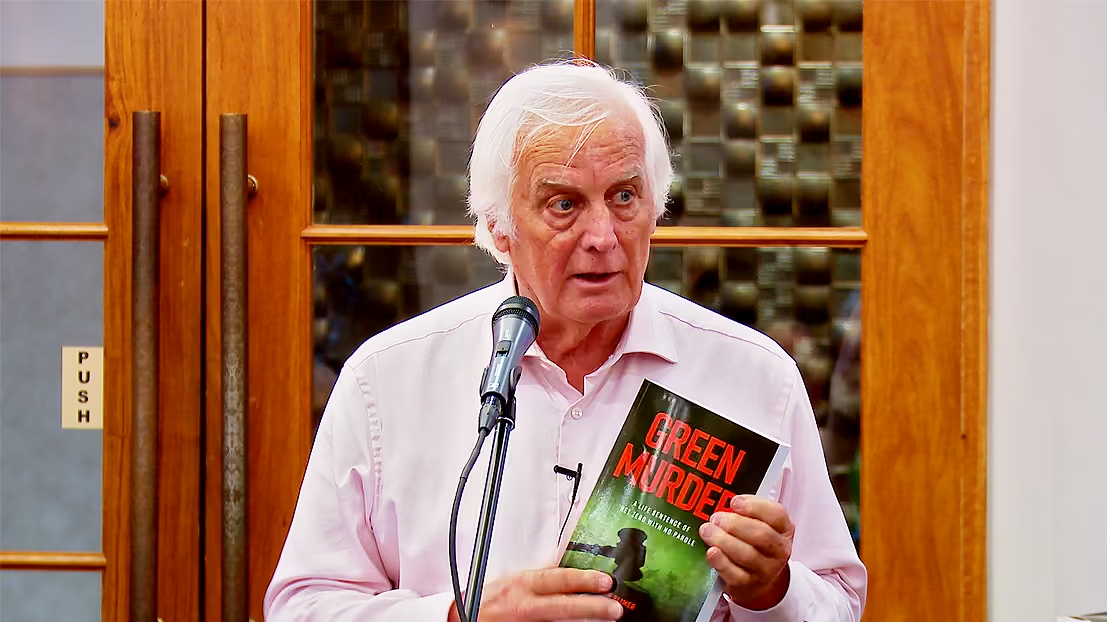
So I open up by a trigger warning saying, I'm sorry folks, but this is really good news. We are living in the best time ever to be a human on planet earth, and yet we are destroying the environment. I look at cow people lived and died before the industrial Revolution, and it was the industrial revolution that got people out working instead of using human muscles and other animals to move heavy equipment, we had steam to drive that and steam was driven by coal. And then I have a brief section here on science funding. I've been in universities for some decades. I've been a professor at four different universities around the world. I've sat on the Australian Research Council, the German Research Council, the Swedish Research Council. And if we did not have politicians deeming that climate change is a catastrophe and we have to fund it, these people would not get any research grants and they'd be totally unemployable.

So we are wasting huge amounts of money on having research into areas of climate, which basically I think is quite unnecessary. I deal with fight with facts. I look at bushfire history in Australia. We are living in good times. I look at the bushfire history around the world. It's actually decreased. I look at the hurricane history. We've got fewer and less intense hurricanes than we've had in the past. I look at droughts, I look at heavy rainfall. I mean, there is a reason why people get flooded on a floodplain. It's got something to do with the word flood. If you build on a floodplain, you are going to get flooded. The floodplain here in the Brisbane River is about 40 million years old in the Nepean River in Sydney. It's nearly 70 million years old. It's been built up by constant flooding. The floods in Brisbane have been far greater in the 19th century than anything you've experienced in your life.

And then I have a little section on the economics looking at what we just heard of in the previous talk. And I've called this in this book, how to Ruin a Country. And if you want to ruin a country, you have expensive energy and we have lost our manufacturing industry. We don't make anything here any longer. There are fundamental things for our survival. We do not make, for example, we don't make ammunition. We import that. We don't make diesel, we import that and one block, eight of one ship. No insurer would've a tanker come into Australia. We have two weeks of diesel in this country. We use diesel for ploughing, for seeding, for weeding, for harvesting, and for transporting food. We are two weeks from crisis in this country because of government policies which have totally and absolutely ignored the fact that burning fossil fuels is the best way to keep your economy running and to keep society as a healthy society.

I have another section on economics where I call Freakonomics, just looking at the history of places like Germany and France and Britain and the US and how they've changed their economies. And then I deal with one of my favourites is fads and fashions and fools and frauds and finances. And I look at electric vehicles. I mean, imagine if you live at Chinchilla, would you have an electric vehicle or if you live at Mount Isa, take you weeks to get here. And there's no charging stations anyway. And I look at some of the child abuse, which I come back to. So this book is a, I think it's the best book I've written. It's a compendium of why we are in our current situation and what it has been like in the past. And I have been very concerned about our children getting abused by fear and by our teachers.

And so I put out this trilogy of books for children, and this trilogy deals with carbon dioxide. Now, how do you talk to an 8-year-old about carbon dioxide or methane or some of the greenhouse gases? Well, what do kids really laugh at an eight year old's, kids laugh at farts. And so this book has mainly about farts and about how your gut works, how you metabolise food, and you breathe out carbon dioxide and your poo and weirs. I've got a section here, poo or die. And this is basically trying to get kids laughing but also telling them they're part of the carbon cycle. And without that carbon cycle, you are dead. And the second book is for teenagers. And teenagers are horrible. They'll open a full fridge of food and say, oh, nothing to eat. So I go into what you eat as a teenager, what you consume, and how the world is a wonderful place.
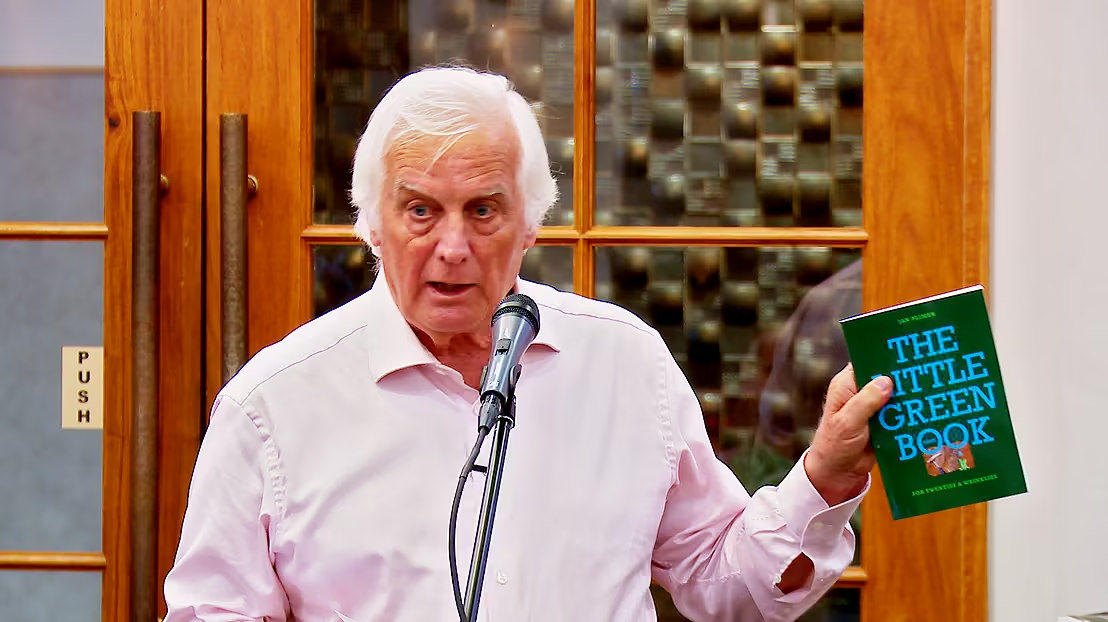
I've got a little section here on hugger plumber. If it were not for plumbers, we wouldn't have reticulated water. We wouldn't have sewage systems. We would die as people did in the past. And I go into temperatures of the past. I go into hurricanes of the past, but then I go into a few moral issues. Teenagers always want to moralise. And if you want to swan around an electric vehicle and fuel morally superior to those clowns, driving a big V eight, which is the right sort of vehicle to drive if you want to feel morally superior in your electric vehicle, then where did the cobalt come from that came from children your age working as slaves in open pit and underground mines in the Congo. And these are operated and owned by the Chinese. So if you want to feel morally superior, go for it, but don't be a hypocrite.

So I go into the hypocrisy that we see coming from the green movement I go into how much energy they use, how much they would use in their phones, and the normal things of cycles of climate and bushfires, et cetera over time. And in the last book for 20th and wrinkles, which includes pretty well. Everyone in this room, I deal with some of the issues in the past, how you're such a lucky group of people. You are living at a period of time when everyone's gone bonkers and not often do people live in times like that. We had them previously with the Dutch tulip craze where people have paid the equivalent of two years pay for just one bulb. And the bubble burst and what became a very wealthy country became a poor country. So I go into the Dutch seal of crows, but I also go into the period of time after the mediaeval warming.

We had a massive cooling. There was a period called the little ice Age. And during the little ice age, we had even colder periods. And I look at the mourned a minimum, and I plotted temperature against the number of witches that were killed. And there's a direct relationship because when it cooled down and the crops failed, and we all starved, you've got to blame someone. So we're currently blaming coal and oil for something that's a natural change. Former times we had to blame someone and we blamed the witches. So what did we do? We rounded up the witches and we killed them. And the ironical thing is that when witch killing stopped, global temperature started to increase. So it works. So this book is written for those who've got no scientific background, is written in the language of the average punter. And it just shows you we've had ice ages in the past.

We're currently in an ice age. We've had carbon dioxide decreasing for a long period of time. We've gone bonkers in the past. We're in one of those periods of time. But there is now quite a bit of evidence coming out that children are medically suffering trauma, believing that the world is coming to an end, believing that we are going to have a climate catastrophe, believing that we haven't got global warm in big global boiling. And we are having young girls now. So I'm not going to have any children. What's the point? The world's going to end. And so this is a book of a collection of people who've written on this subject. I've written on the history. I've got the longest section in this, only because the editor and on the history of people predicting the end of the world. Now, people have done it in the past and everyone in the past who's predicted the world's going to end has failed.

If one was successful, we wouldn't be here. So the logic is not really there. There's a very disturbing chapter on the national curriculum and how kids are being hit with socialist and communist ideas very, very early on and not learning the basics. There's a chapter by a well-known psychiatrist on what damage is being done to children. So what we have now is the whole concept of human induced global warming. I challenge, I'm yet to see the evidence for it. We've got a whole industry, as we just heard, has Gallup along, killing off our farmers, killing off our manufacturing industry, killing off every other industry. We've got our electricity costs, them gone through the roof. People are struggling to pay their electricity costs. Yet it's a fallacy. We are disturbing our young children. We are having a situation where children are reticent to ask questions to their teachers.

Despite the fact that I'm trying to get kids expelled from school, they would get a better education with the home homeschooling anyway. And I'm trying to question, which is what kids ought to learn to do in these little green books question and say, look, I wonder if this is true. And rather than being rude, trying to teach kids to say, oh, that's interesting, show me the evidence. And invariably they get abused. And the end of that abuse is that these kids believe that the world is coming to an end. So this has been a campaign that's gone on by writing books for 15 years, articles for much longer. It's had me banned from a number of, or two, universities have banned me from talking, which I treat as a badge of honour. And we are now, I think, socially, in a very, very serious situation in this country where we have a generation of kids who've suffered from a lack of education in COVID now being frightened witness about the end of the world. And they don't have the weapons to deal with it. So my aim is to give people weapons at all levels to ask simple questions. And you have to know the answer to the question before you ask it, and the answers are in here. So thank you for coming. Thank you for listening. And Jewel, I think you're in charge.

It's NOT the end of the world
Watch the video


TRANSCRIPT: 

(This transcript is derived from an automated process.  The video recording is authoritative.)  


Professor Ian Plimer;

Well folks, thanks for coming out. That was a pretty disturbing talk and you have to ask, well, how did we get here? Because we once had a cheap, reliable electricity system. It was based on coal and we had a grid system, and it worked. And it worked for a very long period of time. And it first started when we were told about emissions and how these emissions were dangerous, and these emissions were pollutants. They didn't tell us that the main emission carbon dioxide was actually plant food. We were not told that the main greenhouse gas was actually water vapour. It's not carbon dioxide at all, but of course you can't ban water vapour, you can't have legislation against it. So the whole house of cards is built on something which is a fallacy. And this had been annoying me for quite a while because as a geologist, we look at rock out crops and we ask ourselves questions.

What was the climate like when this sediment was deposited? Was it glacial? Was it tropical? What was the life doing? Then? Where were we? Were we close to a pole? Were we close to an equator? Had the continents moved? And we look at a rock, say like a limestone, which we can pick from vegetation, and we can look at the rock, and that limestone has 44% gas in it, and that gas is carbon dioxide. Yet we are told that that is a pollutant. Or we look at another carbonate rock dolomite, which has got 48% carbon dioxide in it. So as a geologist, we're saying, well, this doesn't sound right. And then when we look back in time for 80% of time, we have not had ice on planet Earth. Ice is quite a rare rock, and we've had ice ages, we've had eight major ice age, and we can back calculate as to how much carbon dioxide was in the atmosphere.

In the past, every one of these eight ice age had more carbon dioxide in the atmosphere than now. So how can we have carbon dioxide driving global warming? How can we have carbon dioxide giving us a climate catastrophe when we see in the past where we've had ice at the equator at sea level, yet we had 20% carbon dioxide in the atmosphere compared with 0.04%. And this really started to annoy me. And I spent five years reading everything I could read, putting together all of the scientific literature, basically saying, look, what you are being told is not correct. There is no such thing as settled science. And there are thousands of references in the scientific literature showing that that's incorrect. And this book has about three and a half thousand references in it. And I just went through the literature, read it all, and showed that everything you are being told is incorrect.

That carbon dioxide is plant food. The main greenhouse gas is water vapour. That carbon dioxide in the past has been up to 20% in the atmosphere over the last 500 million years. It's been decreasing from 0.7% to 0.04%. And if you want the really bad news, we do have a problem with carbon dioxide. There's just not enough of it. And we have had certain plants develop because there's not enough carbon dioxide in the atmosphere. One of those is corn. We had an original atmosphere, rich in hydrogen and helium. The second atmosphere for most of time was rich in carbon dioxide. Our atmosphere now is rich in oxygen, and we are finding that there has been a massive decrease in carbon dioxide and that is giving us a crisis of life, a crisis of plant life. And without plants, we have no animals. So I've listened to what we're being told.

Everything we were being told was absolutely demonstrably scientifically wrong. And so I wrote this book, Heaven and Earth, and I'd written a couple of books before that. So I took these to my regular publishers and they told me to go away. And there was only one publisher that would take it, and it was recommended to me by a chap in Melbourne said, why don't you try this very small publisher called court? And I gave the book to Anthony, and within a couple of days he said, right, we're going to do this. We're going to print the book. We didn't sign a contract for the book until I think been actually printed before we signed a contract. It was an international success. This was a bestseller worldwide. It came out at a very good time. And this was dealing with everything that we hear about, looking at history, looking at archaeology, looking at geology, looking at mediaeval times when it was much warmer, looking at Viking times when it was cold or looking at Roman times when it was warmer.

And it's very clear that there are cycles of climate, and these cycles are based on where the continents are or what's happening out in the cosmos. These cycles are based on what's happening in the ocean, how close we are to the sun, how much energy the sun's putting out. But the two drivers of climate we see over time the energy that the sun puts out and the distance from the sun. Never in the past have we seen a climate change due to carbon dioxide, never. Carbon dioxide has always been in our atmosphere. It's in the atmosphere of other planets. So what we have is a foundation, which is a house of cars. And over the last 20 years, I've been asking various scientists, especially places like the Scott Polar Institute in Cambridge University, just give me half a dozen scientific papers that demonstrate that human emissions of carbon dioxide drive global warming.

They haven't done it. They haven't been able to do it because no such papers exist. So the whole concept of human driven global warming is a fallacy. Now, perish the thought. What happens if I'm wrong? Well, 3% of all emissions are from humans. The rest are natural. So if you can show that 3% of emissions drive warming, you then have to show that the 97% of natural emissions don't. And that's never been done. So what we just heard is mass scale environmental destruction based on a fallacy. Now, this book is a dense book. It was written to show that there's a huge body of science saying that the popular ideas we have are demonstrably wrong, they just don't exist. There's nothing in the literature. You can search and search and search, and you will not find any landmark scientific papers showing that human emissions drive warming.

And that's of course why we want to close our coal fired power stations and have restrictions on you driving a car or using gas for cooking. And on we go. But this book was dense and I thought, well, maybe I should write something that younger people can use and they can ask their teachers about global warming.

And so this book I put out a bit late, it was called How to Get Expelled from School. And there's 101 questions that the kids can Ask their teachers. And I had the president of the Czech Republic, Dr. Cloth Klaus. He wrote the Forward to it. This was launched by John Howard in Sydney. Oh, did the ABC get into a foam on that one. Anyway, this has got 101 questions that you can ask your teachers. And these questions were deliberately designed. It took a while to get them such that if he said yes, you were wrong.

And if he said no, you were wrong. And I had a special set of questions for Friday afternoon. So if you wanted to get turfed out of school on Friday, I gave you the questions. Now this got up the nose of all of those unemployable people who work in climate institutes. These are people who have failed mathematicians. They work in our climate institutes. They using your money to send you broke and to send up your electricity bills. And under the Gillard government and then the Rudd government, the Gillard government put up a special website using your money. It only cost half a million to try to answer my 101 questions. They couldn't answer them where they couldn't answer 'em, they attacked me. And as soon as Tony Abbott came in as Prime Minister, that website disappeared. So this was a deliberately seditious book giving information that school children could understand, such that they could understand the question they were asking was a valid question, and that that question would nail their teacher.

As an activist, I'm not very popular amongst skilled teachers, and it's not an area of the world that I want to be popular in any way. But I'm also concerned as a geologist, geologists actually go out and there's a couple here who actually go out and look for metals. And we use those metals, we use those metals in our everyday life. And the more civilised the society becomes, the more metals we use and the diversity of metals we use. So if you have a mobile phone, you use 82 of the 92 elements in the periodic table. You cannot get by without using metals. And I thought, well, I might combine metals with energy. And I put out a book not for grains, and it's a book about a teaspoon. How do you make a teaspoon? And I went looking at the history of spoons, how we originally had wooden spoons and bacteria hid in the paws and you'd poison yourself.

And if you're very wealthy, you might be able to have a pewter spoon. If you're even wealthier, you might have a silver spoon. And how in former times people used to travel with a spoon, that was their principle asset and that was their way of stopping dying from poisonous foods. And I went and looked at the modern stainless steel spoon, which has got iron, chromium, nickel in it, sometimes a little bit of molybdenum and tin. So how do you make that spoon? Well, you need any norms, amount of coal, and you need international transport. All the things that the left doesn't like international trade coal. And if you are going to feed yourself and not poison yourself, then you have to have mining of coal, mining of iron mining of chromium in places like South Africa, mining of nickel in places like Indonesia and have national trade such that you've got yourself a spoon to eat with. And what happens when that spoon breaks? Well, you turf it out, you don't recycle it. So this book was trying to show how important energy is to live in the modern world and how you must have large amounts of cheap energy to survive in today's world.

And cheap energy became something of an obsession with me. And I put out another book called Climate Change Delusion and the Great Electricity Ripoff. And we heard a little bit about this, the ripoff of wind, the ripoff of solar. And now of course hydrogen. I mean we tried hydrogen in the 1850s. It failed. We tried in the 18, the 1920s and 1930s it failed. And you can see now some of the hydrogen schemes are starting to fail. Now. God help Gladstone if it ever gets up because the reason I got interested in science was I used to make hydrogen. And hydrogen is a wonderful explosive. You can take out neighbor's windows from a 200 yards away. It is a terrific explosive, and we cannot mine hydrogen. We have to make hydrogen. And if you make hydrogen, you actually use energy to make it and to use, it's an energy loss process.

So here we've got an inefficient process of making energy to make an inefficient product called hydrogen. And then we've got to store it. And the best way to store it is to compress it. So you've only got to compress it 700 times air pressure. You've only got to use enough energy to bring it down to minus 253 degrees Celsius. Of course, easy, but hydrogen actually moves as a gas through solid metal and it weakens that metal. So you store hydrogen in a cylinder, you're going to lose 1% of it per day, plus you've got a beautiful explosion waiting to happen. So in this book I go into why these energy systems such as solar will not work, wind will not work. For example, wind turbine blades are made of balsa wood. So we have to clear some of the Amazonian forests for that balsa. It is inter layered with various epoxies.

One of them is a chemical called bisphenol A that is banned worldwide. It's highly toxic. This is why we can't recycle turbine blades. We just cut them up and leave them in the soil to have the bisphenol a leached into our waterways and soils. You can't recycle it. And the blades are braid. And this best phenol A spreads right across the land in our solar factories. We have cadmium, lead, selenium and tellurium as alloys in those solar panels. And that leaches into the soils and that stays there. So even if your solar factory on prime agricultural land is abandoned, you've still destroyed that land for farming. So I go into some of the wonderful situations that we put ourselves in by claiming that carbon dioxide is a pollutant. Oh, we've got to stop putting the gas of life into the air and kill off all these cheap, reliable, efficient coal fired power stations and go some other direction.

And what we've done is we've opened the doors for the white shoe brigade. They have come in and they're skinning us alive financially, which is why your power prices are going up. So that was the next evolution of my ideas on this. I happened to be locked away for almost a year in a hospital. And what you do in a hospital, you moan and groan. You can't get a drink, so you've got to do something. So I thought I'd write a book and I called that one Green Murder, gentle, non provocative. And basically I look in that book as to how well off we are, what has happened over the last hundred years. Now, 200 years ago, the average longevity was 37 years. We are living longer, we have better health, we have more wealth, we have fewer wars. Everything in today's world is better.

So I open up by a trigger warning saying, I'm sorry folks, but this is really good news. We are living in the best time ever to be a human on planet earth, and yet we are destroying the environment. I look at cow people lived and died before the industrial Revolution, and it was the industrial revolution that got people out working instead of using human muscles and other animals to move heavy equipment, we had steam to drive that and steam was driven by coal. And then I have a brief section here on science funding. I've been in universities for some decades. I've been a professor at four different universities around the world. I've sat on the Australian Research Council, the German Research Council, the Swedish Research Council. And if we did not have politicians deeming that climate change is a catastrophe and we have to fund it, these people would not get any research grants and they'd be totally unemployable.

So we are wasting huge amounts of money on having research into areas of climate, which basically I think is quite unnecessary. I deal with fight with facts. I look at bushfire history in Australia. We are living in good times. I look at the bushfire history around the world. It's actually decreased. I look at the hurricane history. We've got fewer and less intense hurricanes than we've had in the past. I look at droughts, I look at heavy rainfall. I mean, there is a reason why people get flooded on a floodplain. It's got something to do with the word flood. If you build on a floodplain, you are going to get flooded. The floodplain here in the Brisbane River is about 40 million years old in the Nepean River in Sydney. It's nearly 70 million years old. It's been built up by constant flooding. The floods in Brisbane have been far greater in the 19th century than anything you've experienced in your life.

And then I have a little section on the economics looking at what we just heard of in the previous talk. And I've called this in this book, how to Ruin a Country. And if you want to ruin a country, you have expensive energy and we have lost our manufacturing industry. We don't make anything here any longer. There are fundamental things for our survival. We do not make, for example, we don't make ammunition. We import that. We don't make diesel, we import that and one block, eight of one ship. No insurer would've a tanker come into Australia. We have two weeks of diesel in this country. We use diesel for ploughing, for seeding, for weeding, for harvesting, and for transporting food. We are two weeks from crisis in this country because of government policies which have totally and absolutely ignored the fact that burning fossil fuels is the best way to keep your economy running and to keep society as a healthy society.

I have another section on economics where I call Freakonomics, just looking at the history of places like Germany and France and Britain and the US and how they've changed their economies. And then I deal with one of my favourites is fads and fashions and fools and frauds and finances. And I look at electric vehicles. I mean, imagine if you live at Chinchilla, would you have an electric vehicle or if you live at Mount Isa, take you weeks to get here. And there's no charging stations anyway. And I look at some of the child abuse, which I come back to. So this book is a, I think it's the best book I've written. It's a compendium of why we are in our current situation and what it has been like in the past. And I have been very concerned about our children getting abused by fear and by our teachers.

And so I put out this trilogy of books for children, and this trilogy deals with carbon dioxide. Now, how do you talk to an 8-year-old about carbon dioxide or methane or some of the greenhouse gases? Well, what do kids really laugh at an eight year old's, kids laugh at farts. And so this book has mainly about farts and about how your gut works, how you metabolise food, and you breathe out carbon dioxide and your poo and weirs. I've got a section here, poo or die. And this is basically trying to get kids laughing but also telling them they're part of the carbon cycle. And without that carbon cycle, you are dead. And the second book is for teenagers. And teenagers are horrible. They'll open a full fridge of food and say, oh, nothing to eat. So I go into what you eat as a teenager, what you consume, and how the world is a wonderful place.

I've got a little section here on hugger plumber. If it were not for plumbers, we wouldn't have reticulated water. We wouldn't have sewage systems. We would die as people did in the past. And I go into temperatures of the past. I go into hurricanes of the past, but then I go into a few moral issues. Teenagers always want to moralise. And if you want to swan around an electric vehicle and fuel morally superior to those clowns, driving a big V eight, which is the right sort of vehicle to drive if you want to feel morally superior in your electric vehicle, then where did the cobalt come from that came from children your age working as slaves in open pit and underground mines in the Congo. And these are operated and owned by the Chinese. So if you want to feel morally superior, go for it, but don't be a hypocrite.

So I go into the hypocrisy that we see coming from the green movement I go into how much energy they use, how much they would use in their phones, and the normal things of cycles of climate and bushfires, et cetera over time. And in the last book for 20th and wrinkles, which includes pretty well. Everyone in this room, I deal with some of the issues in the past, how you're such a lucky group of people. You are living at a period of time when everyone's gone bonkers and not often do people live in times like that. We had them previously with the Dutch tulip craze where people have paid the equivalent of two years pay for just one bulb. And the bubble burst and what became a very wealthy country became a poor country. So I go into the Dutch seal of crows, but I also go into the period of time after the mediaeval warming.

We had a massive cooling. There was a period called the little ice Age. And during the little ice age, we had even colder periods. And I look at the mourned a minimum, and I plotted temperature against the number of witches that were killed. And there's a direct relationship because when it cooled down and the crops failed, and we all starved, you've got to blame someone. So we're currently blaming coal and oil for something that's a natural change. Former times we had to blame someone and we blamed the witches. So what did we do? We rounded up the witches and we killed them. And the ironical thing is that when witch killing stopped, global temperature started to increase. So it works. So this book is written for those who've got no scientific background, is written in the language of the average punter. And it just shows you we've had ice ages in the past.

We're currently in an ice age. We've had carbon dioxide decreasing for a long period of time. We've gone bonkers in the past. We're in one of those periods of time. But there is now quite a bit of evidence coming out that children are medically suffering trauma, believing that the world is coming to an end, believing that we are going to have a climate catastrophe, believing that we haven't got global warm in big global boiling. And we are having young girls now. So I'm not going to have any children. What's the point? The world's going to end. And so this is a book of a collection of people who've written on this subject. I've written on the history. I've got the longest section in this, only because the editor and on the history of people predicting the end of the world. Now, people have done it in the past and everyone in the past who's predicted the world's going to end has failed.

If one was successful, we wouldn't be here. So the logic is not really there. There's a very disturbing chapter on the national curriculum and how kids are being hit with socialist and communist ideas very, very early on and not learning the basics. There's a chapter by a well-known psychiatrist on what damage is being done to children. So what we have now is the whole concept of human induced global warming. I challenge, I'm yet to see the evidence for it. We've got a whole industry, as we just heard, has Gallup along, killing off our farmers, killing off our manufacturing industry, killing off every other industry. We've got our electricity costs, them gone through the roof. People are struggling to pay their electricity costs. Yet it's a fallacy. We are disturbing our young children. We are having a situation where children are reticent to ask questions to their teachers.

Despite the fact that I'm trying to get kids expelled from school, they would get a better education with the home homeschooling anyway. And I'm trying to question, which is what kids ought to learn to do in these little green books question and say, look, I wonder if this is true. And rather than being rude, trying to teach kids to say, oh, that's interesting, show me the evidence. And invariably they get abused. And the end of that abuse is that these kids believe that the world is coming to an end. So this has been a campaign that's gone on by writing books for 15 years, articles for much longer. It's had me banned from a number of, or two, universities have banned me from talking, which I treat as a badge of honour. And we are now, I think, socially, in a very, very serious situation in this country where we have a generation of kids who've suffered from a lack of education in COVID now being frightened witness about the end of the world. And they don't have the weapons to deal with it. So my aim is to give people weapons at all levels to ask simple questions. And you have to know the answer to the question before you ask it, and the answers are in here. So thank you for coming. Thank you for listening. And Jewel, I think you're in charge.