
Australia’s Public Health System Has Been Captured

The comfort of professional certainty has stymied us from advancing.  Australia’s public health system is a captured racket. God-complex doctors, panicked COVID lockdowns as social control, vaccine risks being ignored, kids are mutilated for the sake of unthinking ideology, NDIS criminal exploitation, and billions wasted on Aboriginal failures. It's time to challenge the medical status quo.

Australia’s Public Health System Has Been Captured

The comfort of professional certainty has stymied us from advancing.  Australia’s public health system is a captured racket. God-complex doctors, panicked COVID lockdowns as social control, vaccine risks being ignored, kids are mutilated for the sake of unthinking ideology, NDIS criminal exploitation, and billions wasted on Aboriginal failures. It's time to challenge the medical status quo.

TRANSCRIPT: 

(This transcript is derived from an automated process.  The video recording is authoritative.) 

Kevin Martin:
Well, first of all, a couple of apologies. I didn't prepare any PowerPoints for tonight. I was under the impression that mine was going to be a pretty short introductory speech, but circumstances have changed and so I've sought to expand some of the comments that I wish to make.

Secondly, whilst I will make some comments about the public service, I'm not going to start on an expose of the way in which the public service really works on particularly the way it used to work as compared with the way in which it currently works, because it has to be said, we don't have a public service anymore. We have a party political organisation that supports ministers of the Crown, both Commonwealth and state level. The concept of a bureaucracy in the Prussian sense and in the old Westminster sense of apolitical, experienced, loyal, trained public servants does not exist anymore.

More to the penny, but that's life the way it goes.

Indeed, that's what I want to start out talking about and that's life itself. One of the great things about human beings are that we never really acknowledge that we're going to die.

Human beings are born, we live, and we die. We've been doing that for millions of years according to the anthropologists and the geologists. And that's the fate that all of us have. Yet we all have within us this idea that somehow or other we can live a little longer and we've got people who are going to help us live a little longer.

Once upon a time they were called shamans or witch doctors. They are now called medical professionals. The medical profession is a unique profession because they are, when it comes to human life, all powerful. If you are a medical practitioner with your hand inside an open chest holding a beating heart whilst you are conducting some aortic surgery on it, as has happened to me and I suspect has probably happened to a significant number of people within this room, the power of the God complex is very easy to be adopted.

The medical profession has the capacity to extend our lives. If the radical profession comes up with the correct diagnosis of an individual, disease can be alleviated, disease can be cured. Of course, this is what the medical profession has all been about.

From those days when they rattled the bones, played with the goods, cast the stones and worked out what they would do for an individual. Even in those primitive days, the mystery of the medical professional gave them an enhanced status and standing in the various societies in which they were.

We are lucky today in this 21st century that the medical profession has passed on from those days of casting stones to work out a diagnosis to modern medicine. And we've got to thank pioneers who built modern medicine, people like Pastor, people like Lister, people who challenged the then status quo and through their endeavours proved that the practises then currently in existence, then currently applied by all the leaders of the medical sphere, were wrong.

They were introduced in the days when they suggested, well, there might be a thing called germs and so you better use some antiseptic to kill those germs.

Today, that same approach still continues to exist because we want to live. We continue to hold the medical profession in the greatest of esteem. That has resulted in a bureaucracy being created in the hospitals and the health systems, which consumes ever increasing resources of every society.

You do not ever find politic politicians and political leaders ever game to really take on the medical profession. Purely on the grounds of economics as a first instance, let alone anything about what is being practised in medicine.

The politicians and governments will never take on the medical profession because they know the medical profession interreacts so closely with individual citizens that if the doctors start criticising the government of the day, that government will inevitably fall.

And so we've seen a situation where ever-increasing resources are being poured into a medical system with a medical system being led by doctors for whom we give the greatest respect who are in their sphere more powerful than any other institution.

One of the most strongest trade unions in this country is the Australian Medical Association. And I know when I was in government there, you didn't do anything that upset the AMA because the AMA had real power behind the scenes.

Now, what does that say about us as a society? It says that we automatically give credence to the views of the leaders of these medical societies, yet the reality is the leaders of these medical societies are no more than people who express the status quo. You don't find the medical societies challenging the status quo. What they want is more resources continuing to be put into the things that they have done.

Progress proceeds in a like in a manner which is glacial in many ways. You do find the Maverick medical practitioner who will be revolutionary, who will introduce new ideas, but you don't go too far. Don't become a Charlie Teo and go out there and operate on the real edge seeking to help people who the rest of the profession has said, "There's nothing we can do, go away and die and don't cause any problems." You don't find it in the case of other practitioners who challenge the status quo.

The problem is just as pastor and lister and all the other pioneers of modern medicine developed their science by challenging the status quo, nowadays our society is too concerned with preserving the status quo rather than challenging it. Scientific progress only occurs when whatever is the proposition is subject to challenge. Einstein's theory of relativity was supposed to be the endpoint.

It's why he was such a genius in explaining motion, energy, light.

Einstein is now being challenged and indeed there are reputable scientists who say Einstein was if he wasn't wrong, he certainly did not understand the whole nature of the science he was seeking to address. And that again is the part of the process of scientific progress.

Now what that means is if you have a truth, you subject that truth to trial. 99.9% of the time the truth may be repeated, but that says that 0.1% where all of a sudden the truth is open to question and it needs to be examined and in examining that variation is where science proceeds and science grows and knowledge expands.

We have the same problem in the medical profession and the area of vaccines.

The reality is for the vast majority of human beings, vaccines do not have adverse impacts. They have positive impacts, but for a percentage of the community, albeit a small percentage, the use of a common vaccine can create real problems. It can lead to death, yet the medical profession as a whole tends to focus upon the benefit for the majority as opposed to examining what happens to the minority and how can that minority be protected from the adverse influences and politicians when they support vaccines fail to acknowledge that there is always that risk factor there in the use of vaccines.

Explanation to the community of the risk versus the reward involved in the use of vaccines would make them far more acceptable than what we have now at the community where you have one view on one hand, one view on the other hand and never will those views meet and bad public policy arises.

Now in the bureaucracy, there has grown up over basically since the middle of mid-Victorian era where they suddenly found out issues about contaminated water in wealth causing typhoid, et cetera. There's been a growth in a race of bureaucrats called public health officials.

Nasty people make this comment about public health officials like they make about teachers. If they were any good, they'd be doing something so they're questionable so they go and teach. And so some nasty people make those comments about public health officials. No doubt, many of them are good, honest citizens who try to do what is right.

The problem is many of them are not people of great drive or intellectual curiosity and so they become very bureaucratically entwined. And when you're dealing with public health officials in a health bureaucracy based upon a medical profession, which regards itself as the font of all wisdom and knowledge and looks down upon the rest of the community, you get this approach to public health.

Now in the past we've had the situation of the public health officials being required to confront pandemics and anyone who studied the history of the 1919 Spanish flu pandemic, which spread across the world and killed millions of people will realise how little the public health officials of that day knew about handling pandemics and the policies that they pursued were basically the policy of isolation and let the disease burn itself out.

We come to the COVID-19 era. Now one would have hoped in the 50, 60 years of development that has gone on since the 1919 Spanish flu, that the public health officials of the day would have learned something about handling pandemics. After all, we've had exercises with Ebola and other mad cow disease, et cetera, which should have provided learning lessons.

As Gary says in his book and outlines in his book, it is fair to say that the public health officials when confronted with the COVID-19 pandemic panicked, they didn't know what to do. What they did do, however, was provide cover for the politicians to enable the politicians to engage in an experiment in social control.

The public health officials had no regard for the human rights of the individual rights of the people who were potentially going to be affected by this pandemic. Instead, they supported the draconian policies of lockup, lockdown, and let the disease burn itself out.

All the efforts in relation to developing vaccines were merely by play. The reality was in COVID-19 we applied the public health policies of the early 20th century, which in turn reflected the public health policies back to the days of the plague in Europe. There's nothing we can do. We can't address the issue. We don't know really what's causing it so let's close it all down and just let it burn itself out.

And the reality is that's what's happens with most diseases. Human beings, you will either live or you will die. And if you live, you've got the genetic power and strain to enable you to overcome the challenge of the disease and that's been repeated time and time again.

In societies right the way across the world from Europe during the plague years, through India, China, Africa, that's the nature of human beings. Too bad, too sad if you happen to be one of the ones who die of the disease, but that's life.

One would hope bureaucrats whose job and profession is to address public health issues would have come up with more effective solutions by the 21st century. They didn't.

Gary's book also outlines some other major issues where public health officials have either been captured by vested interest groups or public health officials have been part of the roarting of the taxpayer and the community.

In relation to the gender issue the time will come when people are going to look back and wonder why on earth public health officials allow children to be mutilated and subject to drastic drug regimes without anyone saying, "Is this appropriate for a young person who does not have at law or in reality the capacity to make decisions for themselves?" Unfortunately in Queensland, it would seem both the government and the health minister lack the moral fortitude to address this issue in the same way they have lacked the moral fortitude to address other issues where medicine and morality and humanity intertwine.

Gary and his book also looks at the Aboriginal health issue. If there is nothing more that is of shame to Australia and its people and its governments, it is the fact that for the last 30 years we have been pouring hundreds, thousands of millions of dollars into Aboriginal health and Aboriginal housing and Aboriginal services. And we've only got to look at what happened in Alice Springs in the last couple of months to see how that has been a total failure.

There has been a group of Aboriginals and white advisors who have waxed fat upon the millions of dollars that have been poured into these schemes, but have they improved the lot of those Aboriginal people and the children who they bear? No, they haven't. What happens in Alice Springs would make places like Sudan and Ethiopia look better than Australia. At our governments, both sides beat their chests, say what marvellous people we are, but they're failing to deliver.

Again, they are being supported in this approach by the public health officials who manage these programmes. Oh, just give us more money, more money, more money. That's the answer that they come up with. And the same way with the NDIS, which Gary also highlights.

We have had a government in Australia which has facilitated the growth of a criminal empire through the NDIS. The tales that exist about the exploitation of disabled people by the Middle Eastern gangs, particularly in Western Sydney, but not only there, but right the way throughout Australia would curdle your hair.

Now, I was in government when NDIS was introduced and the Feds came to us in Queensland and they said to us, "We're going to establish this NDIS scheme. You're going to hand over your responsibility for looking after disabled people."

But our experts have told us that once we establish the NDIS, once we provide these disabled people with the support that they need to enable them to get on with life with the rest of the Australian community, they're going to go out, they're going to get jobs, they're going to be useful citizens contributing to Australia, they're going to pay tax and the tax that they pay will more than offset any cost we're expending.

In actual fact, NDIS will be a positive revenue boost for the Commonwealth of Australia.

And they said that to us quite openly and quite clearly and naturally, of course, our local politician said, "Oh, marvellous. We can get rid of the responsibility and we're going to make a quit out of it as well too."

Well, we've all seen what's happened with the NDIS. It is a bottomless pit where you have the medical profession facilitating the adding of more and more people to the NDIS. What has happened in the case of children with allegedly ADHD, the disease of the modern with it young child generation is happening not only there but right the way across the spectrum, particularly in relation to alleged mental health issues.

We need to address those issues. We need to address the consensus that supports those types of policies. We need to challenge them and that's what Gary and McFedren have done in their book. They have challenged the status quo. They have challenged the accepted position. They have challenged the medical establishment. They have challenged the medical leaders.

Will they be listened to? Well, I've been around in the game long enough to have my real doubts about whether they'll be listened to, but the reality is someone needs to make the challenge. Only when you have the accepted status quo being challenged, can you identify the flaws in the status quo? Can you then come up with solutions in relation to those flaws?

Now in doing that, you might identify other flaws and you'll start the process again, but that's the scientific method. That's the way in which progress has been achieved by human beings over the last few hundred years, few thousand years.

Going back to the days of the Greek philosophers argument, counter argument, synthesis, new conclusion, then you start the process again. The people who in the past have challenged, have not always been successful. Some of them have been put on trial. Remember Miguel was tried because he said, "The world revolves around the sun."

People who attacked what was then accepted science did not always succeed, but the reality of life is even the hardest rock can be chipped away at one bit at a time. And that's what this book, which Gary's going to launch shortly is doing. It is part of that chipping away.

Every profession should be prepared to look at itself and say, "Are we really achieving what our profession is supposed to achieve?" I know my own profession, the legal profession fails in that regard time after time when we look at what some of the judges decide is supposedly the law.

The medical profession also needs and health practitioners and public health practitioners need to adopt the same approach. Don't? I hope this is not a voice crying in the wilderness. I hope this is another step forward in starting to address the problems in issues where there are real problems.

I congratulate Gary and all the work that he has done and wish him well and hope that the profession does listen to it. If it doesn't, at least we should listen to it and in our own small way, keep the pressure up to demand better outcomes and demand better public health than we currently receive in so many areas.

Thank you. Thank you so much.
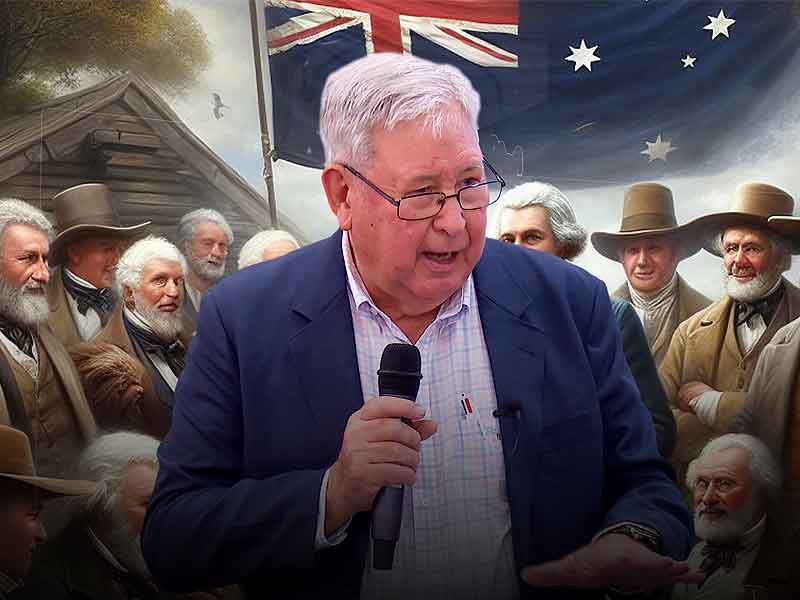
Australia’s Public Health System Has Been Captured
Watch the video

TRANSCRIPT: 

(This transcript is derived from an automated process.  The video recording is authoritative.) 

Kevin Martin:
Well, first of all, a couple of apologies. I didn't prepare any PowerPoints for tonight. I was under the impression that mine was going to be a pretty short introductory speech, but circumstances have changed and so I've sought to expand some of the comments that I wish to make.

Secondly, whilst I will make some comments about the public service, I'm not going to start on an expose of the way in which the public service really works on particularly the way it used to work as compared with the way in which it currently works, because it has to be said, we don't have a public service anymore. We have a party political organisation that supports ministers of the Crown, both Commonwealth and state level. The concept of a bureaucracy in the Prussian sense and in the old Westminster sense of apolitical, experienced, loyal, trained public servants does not exist anymore.

More to the penny, but that's life the way it goes.

Indeed, that's what I want to start out talking about and that's life itself. One of the great things about human beings are that we never really acknowledge that we're going to die.

Human beings are born, we live, and we die. We've been doing that for millions of years according to the anthropologists and the geologists. And that's the fate that all of us have. Yet we all have within us this idea that somehow or other we can live a little longer and we've got people who are going to help us live a little longer.

Once upon a time they were called shamans or witch doctors. They are now called medical professionals. The medical profession is a unique profession because they are, when it comes to human life, all powerful. If you are a medical practitioner with your hand inside an open chest holding a beating heart whilst you are conducting some aortic surgery on it, as has happened to me and I suspect has probably happened to a significant number of people within this room, the power of the God complex is very easy to be adopted.

The medical profession has the capacity to extend our lives. If the radical profession comes up with the correct diagnosis of an individual, disease can be alleviated, disease can be cured. Of course, this is what the medical profession has all been about.

From those days when they rattled the bones, played with the goods, cast the stones and worked out what they would do for an individual. Even in those primitive days, the mystery of the medical professional gave them an enhanced status and standing in the various societies in which they were.

We are lucky today in this 21st century that the medical profession has passed on from those days of casting stones to work out a diagnosis to modern medicine. And we've got to thank pioneers who built modern medicine, people like Pastor, people like Lister, people who challenged the then status quo and through their endeavours proved that the practises then currently in existence, then currently applied by all the leaders of the medical sphere, were wrong.

They were introduced in the days when they suggested, well, there might be a thing called germs and so you better use some antiseptic to kill those germs.

Today, that same approach still continues to exist because we want to live. We continue to hold the medical profession in the greatest of esteem. That has resulted in a bureaucracy being created in the hospitals and the health systems, which consumes ever increasing resources of every society.

You do not ever find politic politicians and political leaders ever game to really take on the medical profession. Purely on the grounds of economics as a first instance, let alone anything about what is being practised in medicine.

The politicians and governments will never take on the medical profession because they know the medical profession interreacts so closely with individual citizens that if the doctors start criticising the government of the day, that government will inevitably fall.

And so we've seen a situation where ever-increasing resources are being poured into a medical system with a medical system being led by doctors for whom we give the greatest respect who are in their sphere more powerful than any other institution.

One of the most strongest trade unions in this country is the Australian Medical Association. And I know when I was in government there, you didn't do anything that upset the AMA because the AMA had real power behind the scenes.

Now, what does that say about us as a society? It says that we automatically give credence to the views of the leaders of these medical societies, yet the reality is the leaders of these medical societies are no more than people who express the status quo. You don't find the medical societies challenging the status quo. What they want is more resources continuing to be put into the things that they have done.

Progress proceeds in a like in a manner which is glacial in many ways. You do find the Maverick medical practitioner who will be revolutionary, who will introduce new ideas, but you don't go too far. Don't become a Charlie Teo and go out there and operate on the real edge seeking to help people who the rest of the profession has said, "There's nothing we can do, go away and die and don't cause any problems." You don't find it in the case of other practitioners who challenge the status quo.

The problem is just as pastor and lister and all the other pioneers of modern medicine developed their science by challenging the status quo, nowadays our society is too concerned with preserving the status quo rather than challenging it. Scientific progress only occurs when whatever is the proposition is subject to challenge. Einstein's theory of relativity was supposed to be the endpoint.

It's why he was such a genius in explaining motion, energy, light.

Einstein is now being challenged and indeed there are reputable scientists who say Einstein was if he wasn't wrong, he certainly did not understand the whole nature of the science he was seeking to address. And that again is the part of the process of scientific progress.

Now what that means is if you have a truth, you subject that truth to trial. 99.9% of the time the truth may be repeated, but that says that 0.1% where all of a sudden the truth is open to question and it needs to be examined and in examining that variation is where science proceeds and science grows and knowledge expands.

We have the same problem in the medical profession and the area of vaccines.

The reality is for the vast majority of human beings, vaccines do not have adverse impacts. They have positive impacts, but for a percentage of the community, albeit a small percentage, the use of a common vaccine can create real problems. It can lead to death, yet the medical profession as a whole tends to focus upon the benefit for the majority as opposed to examining what happens to the minority and how can that minority be protected from the adverse influences and politicians when they support vaccines fail to acknowledge that there is always that risk factor there in the use of vaccines.

Explanation to the community of the risk versus the reward involved in the use of vaccines would make them far more acceptable than what we have now at the community where you have one view on one hand, one view on the other hand and never will those views meet and bad public policy arises.

Now in the bureaucracy, there has grown up over basically since the middle of mid-Victorian era where they suddenly found out issues about contaminated water in wealth causing typhoid, et cetera. There's been a growth in a race of bureaucrats called public health officials.

Nasty people make this comment about public health officials like they make about teachers. If they were any good, they'd be doing something so they're questionable so they go and teach. And so some nasty people make those comments about public health officials. No doubt, many of them are good, honest citizens who try to do what is right.

The problem is many of them are not people of great drive or intellectual curiosity and so they become very bureaucratically entwined. And when you're dealing with public health officials in a health bureaucracy based upon a medical profession, which regards itself as the font of all wisdom and knowledge and looks down upon the rest of the community, you get this approach to public health.

Now in the past we've had the situation of the public health officials being required to confront pandemics and anyone who studied the history of the 1919 Spanish flu pandemic, which spread across the world and killed millions of people will realise how little the public health officials of that day knew about handling pandemics and the policies that they pursued were basically the policy of isolation and let the disease burn itself out.

We come to the COVID-19 era. Now one would have hoped in the 50, 60 years of development that has gone on since the 1919 Spanish flu, that the public health officials of the day would have learned something about handling pandemics. After all, we've had exercises with Ebola and other mad cow disease, et cetera, which should have provided learning lessons.

As Gary says in his book and outlines in his book, it is fair to say that the public health officials when confronted with the COVID-19 pandemic panicked, they didn't know what to do. What they did do, however, was provide cover for the politicians to enable the politicians to engage in an experiment in social control.

The public health officials had no regard for the human rights of the individual rights of the people who were potentially going to be affected by this pandemic. Instead, they supported the draconian policies of lockup, lockdown, and let the disease burn itself out.

All the efforts in relation to developing vaccines were merely by play. The reality was in COVID-19 we applied the public health policies of the early 20th century, which in turn reflected the public health policies back to the days of the plague in Europe. There's nothing we can do. We can't address the issue. We don't know really what's causing it so let's close it all down and just let it burn itself out.

And the reality is that's what's happens with most diseases. Human beings, you will either live or you will die. And if you live, you've got the genetic power and strain to enable you to overcome the challenge of the disease and that's been repeated time and time again.

In societies right the way across the world from Europe during the plague years, through India, China, Africa, that's the nature of human beings. Too bad, too sad if you happen to be one of the ones who die of the disease, but that's life.

One would hope bureaucrats whose job and profession is to address public health issues would have come up with more effective solutions by the 21st century. They didn't.

Gary's book also outlines some other major issues where public health officials have either been captured by vested interest groups or public health officials have been part of the roarting of the taxpayer and the community.

In relation to the gender issue the time will come when people are going to look back and wonder why on earth public health officials allow children to be mutilated and subject to drastic drug regimes without anyone saying, "Is this appropriate for a young person who does not have at law or in reality the capacity to make decisions for themselves?" Unfortunately in Queensland, it would seem both the government and the health minister lack the moral fortitude to address this issue in the same way they have lacked the moral fortitude to address other issues where medicine and morality and humanity intertwine.

Gary and his book also looks at the Aboriginal health issue. If there is nothing more that is of shame to Australia and its people and its governments, it is the fact that for the last 30 years we have been pouring hundreds, thousands of millions of dollars into Aboriginal health and Aboriginal housing and Aboriginal services. And we've only got to look at what happened in Alice Springs in the last couple of months to see how that has been a total failure.

There has been a group of Aboriginals and white advisors who have waxed fat upon the millions of dollars that have been poured into these schemes, but have they improved the lot of those Aboriginal people and the children who they bear? No, they haven't. What happens in Alice Springs would make places like Sudan and Ethiopia look better than Australia. At our governments, both sides beat their chests, say what marvellous people we are, but they're failing to deliver.

Again, they are being supported in this approach by the public health officials who manage these programmes. Oh, just give us more money, more money, more money. That's the answer that they come up with. And the same way with the NDIS, which Gary also highlights.

We have had a government in Australia which has facilitated the growth of a criminal empire through the NDIS. The tales that exist about the exploitation of disabled people by the Middle Eastern gangs, particularly in Western Sydney, but not only there, but right the way throughout Australia would curdle your hair.

Now, I was in government when NDIS was introduced and the Feds came to us in Queensland and they said to us, "We're going to establish this NDIS scheme. You're going to hand over your responsibility for looking after disabled people."

But our experts have told us that once we establish the NDIS, once we provide these disabled people with the support that they need to enable them to get on with life with the rest of the Australian community, they're going to go out, they're going to get jobs, they're going to be useful citizens contributing to Australia, they're going to pay tax and the tax that they pay will more than offset any cost we're expending.

In actual fact, NDIS will be a positive revenue boost for the Commonwealth of Australia.

And they said that to us quite openly and quite clearly and naturally, of course, our local politician said, "Oh, marvellous. We can get rid of the responsibility and we're going to make a quit out of it as well too."

Well, we've all seen what's happened with the NDIS. It is a bottomless pit where you have the medical profession facilitating the adding of more and more people to the NDIS. What has happened in the case of children with allegedly ADHD, the disease of the modern with it young child generation is happening not only there but right the way across the spectrum, particularly in relation to alleged mental health issues.

We need to address those issues. We need to address the consensus that supports those types of policies. We need to challenge them and that's what Gary and McFedren have done in their book. They have challenged the status quo. They have challenged the accepted position. They have challenged the medical establishment. They have challenged the medical leaders.

Will they be listened to? Well, I've been around in the game long enough to have my real doubts about whether they'll be listened to, but the reality is someone needs to make the challenge. Only when you have the accepted status quo being challenged, can you identify the flaws in the status quo? Can you then come up with solutions in relation to those flaws?

Now in doing that, you might identify other flaws and you'll start the process again, but that's the scientific method. That's the way in which progress has been achieved by human beings over the last few hundred years, few thousand years.

Going back to the days of the Greek philosophers argument, counter argument, synthesis, new conclusion, then you start the process again. The people who in the past have challenged, have not always been successful. Some of them have been put on trial. Remember Miguel was tried because he said, "The world revolves around the sun."

People who attacked what was then accepted science did not always succeed, but the reality of life is even the hardest rock can be chipped away at one bit at a time. And that's what this book, which Gary's going to launch shortly is doing. It is part of that chipping away.

Every profession should be prepared to look at itself and say, "Are we really achieving what our profession is supposed to achieve?" I know my own profession, the legal profession fails in that regard time after time when we look at what some of the judges decide is supposedly the law.

The medical profession also needs and health practitioners and public health practitioners need to adopt the same approach. Don't? I hope this is not a voice crying in the wilderness. I hope this is another step forward in starting to address the problems in issues where there are real problems.

I congratulate Gary and all the work that he has done and wish him well and hope that the profession does listen to it. If it doesn't, at least we should listen to it and in our own small way, keep the pressure up to demand better outcomes and demand better public health than we currently receive in so many areas.

Thank you. Thank you so much.