
TRANSCRIPT:
(This transcript is derived from an automated process. The video recording is authoritative.)
Lyle Shelton:
Fantastic. Thank you so much, Jewel. It's an absolute privilege to be back here at Voting Matters again. I think the first time I was up at the Mount Gravatt Bowls Club, and it's wonderful to be in a much nicer venue. And I really appreciate Jewel's kind introduction and what she does to help educate the public. There's so much lack of knowledge about politics, and it's part of the reason why we're in such a mess.
It's great to see so many friends here, people that I've known for many, many years, and some great people from my childhood from the 1970s here. Great to see Greg and Vida and Doris. And it's always daunting when you've got former teachers in the room. So one of my former high school teachers, Andrew McColl. Jules said some very nice things to me at the start there. You have to know that I'm not the Messiah, I'm just a very naughty boy. And Andrew knows that because he had me in year 11, I think, and 12 perhaps. So great to see you here, Andrew.
And also Scott Prasser was my politics lecturer at the University of Southern Queensland. And it's great to see you again, Scott. He's played a key role in Australian politics for many, many decades. In fact, I feel a bit intimidated talking about politics here with a former teacher and a former lecturer, but we'll give it a go.
As Jewel said, I've written this book. It's my second book. I've been a political activist, I guess is probably the best way to describe me. I've been a failed candidate on numerous occasions. I've been wandering around the edges of politics for close to 30 years. I was elected to the Toomba City Council, which is my hometown just up the road in the year 2000.
I served six and a half years there and then had a tilt at state politics, which was unsuccessful with the Queensland Nationals. And then I spent 10 years in Canberra with the Australian Christian Lobby, which was a really terrific opportunity in my local government experience, the experience of being part of a major party. And also my church experience was very valuable in that. And we lobbied on the sort of values that I'll be talking about tonight to people like Kevin Rudd and Scott Morrison and the like, and saw a lot of interesting things happen over those 10 years.
Since then, I left ACL, still love the organisation, very much in touch with them, but I've spent the last few years in the minor party political world because I just came to the view that yes, lobbying is important and you certainly need your advocacy groups, but I really felt we needed to give people who cared about family, marriage, the pro-life issues, which I'm very passionate about, we needed to be able to give them an ethical opportunity to vote and exercise that on the ballot paper and then hopefully to get people into parliament.
So I lead the Family First Party. It's a party that's been around for about 20 years. It's had a bit of a checked history. It's had senators, it's had people in state parliaments, particularly in South Australia. And it was closed down for a little while. We merged with Corey Bernardi's party. Some of you were involved in that project with me back in the day. There's lots of failed spilt milk efforts in this space.
And then in the last four or five years, Family First was revitalised and I've been working with that party. We've been running in pretty much every Australian and territory election, state and territory election since about 2021. We've fielded hundreds of candidates, we've raised millions of dollars and we've got no one in parliament yet, but we're working on it. In fact, that's not true. We had a former One Nation parliamentarian in South Australia join us in June, Sarah Gain.
And so we actually do have parliamentary representation, but we haven't achieved it through the ballot boxes yet. And we're hoping that as I run for the New South Wales Upper House next March, that we might be able to make our breakthrough there, but time will tell.
As someone who's been an activist for a long time and particularly trying to get Christian people in particular, and I recognise not everyone in this room is from the Christian religion and that's fine. I think a lot of Australians still identify as people who support the Judeo-Christian ethic, but there's a lot of Christians in Australia, even though Christianity has been declining, there's still a big proportion of the population. It's still a big constituency. But by and large, the part of the church that I'm from, the sort of evangelical, Pentecostal, charismatic sort of world, they've been missing in action in politics.
And I guess the discussion that we were having a lot during my time at the ACL, and particularly as we went through the same-sex marriage campaign is where is the church? They were just missing in action.
And so I've had a lot of thoughts about that question. And this book, Turn the Tide, A Letter to the Antipodian Church, is my attempt to try and answer that question. So essentially it's a collection of essays. It's not super well structured, but I've got three quasi theological chapters. I talk about a drag queen case that I'm involved in and a whole bunch of other things. And I'll just step you through some of the contents of the book tonight just to try and wet your appetite and hopefully encourage you to consider perhaps purchasing it, not because it's not about the money, but it's about getting a message out there, which I think is an important discussion that's needed, not just for the church, but for the wider Australian community.
I wrote it to the Church of Australia and New Zealand for a couple of reasons, even though I'm Australian. My wife and my daughter married a New Zealander about six years ago and they live in a place called Fongerei. Has anyone been to Fongarei? A few people? Yep. It's a great part of the world. And so I've come to love New Zealand as a frequent visitor over the last few years, and we've got two grandsons there.
And I've also had a longstanding friendship with a man called Bob McCoskery who runs Family First in New Zealand. They're not a political party. They're more like the ACL, an advocacy group, but New Zealand has gone very woke, gone down a very leftist path. And Bob is really the last line of defence there. So there's a strong connection. And so 12 months ago, in July last year, my board very kindly gave me three weeks of writer's leave and I went to New Zealand.
I had an ulterior motive. We had family there, of course. But the New Zealand family has what's called a batch up on the Bay of Islands. Now a bach, B-A-C-H is a New Zealand thing. Lots of New Zealanders have them. They're basically a beach shack on a bit of carved off farmland on the side of the water. And it's a very beautiful place and no one's ever up there in winter time because it's freezing cold.
But I though what better place to go and start writing a book. And in the early hours of one of the mornings while I was up there, I was up there for three weeks. Has anyone ever spent three weeks on their own? It's a very surreal experience actually. I actually really enjoyed it. It was just to shut out of the world and to concentrate on a project.
But because I'm an old man, you wake up at three o'clock in the morning sometimes for reasons that you can't explain. And so I got up and just started doing a bit of work and I was right near the bay on the Bay of Islands and you could hear the little waves sort of lapping in as they do every day. And they were just lapping in and I was thinking, what am I going to call this book? And I just though, yeah, it's turn the tide.
And so a mate of mine is a photographer. He took me down to Sydney Harbour earlier in the year and he wanted me to put on my suit and wade into the water with my suit on. And I said, no, Wayne, I'm not doing that. But he got me to stand there in my RM Williams boots and he took those photos. Yes folks, I do my own stunts. So that is me.
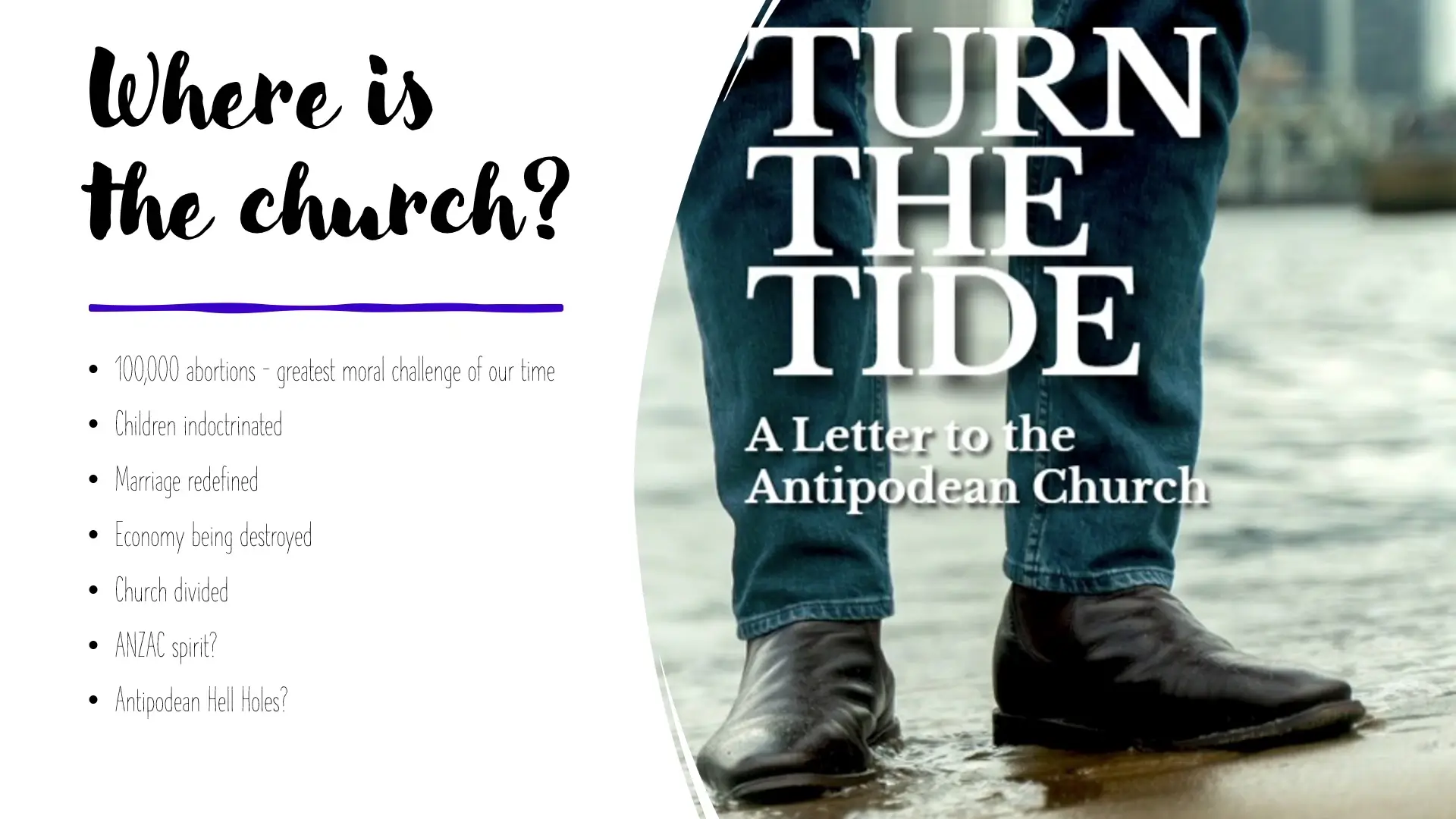
So this book has arisen, as I say, out of this question of where is the church? In Australia, there's a whole lot of things that are wrong with Australia. And at the top of my list is something which I know is probably a bit controversial, but human rights for unborn babies and proper support and care for their mothers is something we have sorely neglected over the last 40 or 50 years. And we now have a hundred thousand abortions here.
And I just think that's the greatest moral challenge of our time, not what Kevin Rudd said that climate change was. So to me, that's indicative of a society that doesn't care for the most vulnerable. Our children are being indoctrinated by woke ideology, particularly the gender fluid ideology.
We've got an epidemic of children now presenting at child gender clinics all over the country, including here in Queensland at the Children's Hospital in South Bank where thousands and thousands of kids are being prescribed pupilty blockers and cross-sex hormones. They're injected with these things, which makes them sterile. Some kids go on to have mutilating surgery.
Marriage has been redefined. I was involved in the marriage campaign and I know some of you were volunteers and helped us in that back in 2017. For many years in the lead up to that, the organisation I was part of tried to warn Australia that if you redefine marriage, you're going to have the onslaught of this gender fluid ideology. And of course all that's been turbocharged since.
And of course, redefining marriage has meant injustice to children. And I'll talk about some of those injustices a little later as I've covered that in the book.
The economy is being destroyed by net zero, by the climate cult. And look, I'm not suggesting that humans might not have some impact on climate change. I don't know. I tend to be more in the Ian Plimer school and I think he makes a very compelling case, but certainly what we're doing in restructuring the economy to make our electricity far more expensive and to deindustrialize is just madness.
And of course the Europeans have seen that and they're walking away from this at a great rate of knots if you look at what's happening in Germany in particular. But here in Australia, we are still going headlong into this and it's just crazy.
The church, which I'm very passionate about, is very divided. I'll talk about that.
The Anzac spirit. Yeah, we all go to Anzac Day, but if you ask young people, would you be prepared to fight for your country? Survey shows big numbers of them wouldn't do what my great uncle did as a 21 year old and went off to Gallipoli and died on the first day.
And then I just think that Australia and New Zealand are in danger and I'll try and get optimistic towards the end, but we've got to make a sober assessment of where we are. We're in danger of becoming Antipodean hellholes.
Now I should just explain that word Antipodean. So the book is called Turn the Tide: Letter to the Antipodean Church. Does anyone know what Entipodean means? Yeah, some nods. What does it, Greg? Australian New Zealand. Yeah, very good. It's a geographical term that relates to the juxtaposition of Australia and New Zealand to the British Isles, which were the countries that gave birth to our great nations. And we were known as the Antipodes.
And so I wanted to sort of capture that because the issues that we face are common to both nations. The similarities are very striking. But 20 minutes up the road from this batch on the Bay of Islands where I was riding for those three weeks was a town called Russell, which has become one of my favourite towns in the world. And Russell was the place of the first white settlement in New Zealand.
In fact, it was a whaling station. American whalers used to come through. And of course with whaling and men and all of this sort of stuff, it was a lawless place. It was full of vice and prostitution, women being abused for the benefit of men and all of this sort of stuff. It was known as the hell hole of the South Pacific. But then the Christian missionaries came along and to this day, the old Catholic mission is still there. It's a tourist attracting beautiful old buildings.
They came and the place was transformed. It went from being a hellhole to one of the most beautiful places that you'll see, but it was a dangerous place. The old Anglican church that's still there has the remnants of bullet holes. Well, it has the bullet holes in the weatherboard of the old church.
And it's very interesting to me because the bullet holes are concentrated around the windows. There was obviously someone shooting out from the windows and it was a battle between the Maori and some of the local white settlers. So it was a violent place back in the day.
And I guess the question I'm asking is, can we recover our nations or will we end up becoming hellholes again? Again, for those who are not Christians, please bear with me and perhaps I might just skip over some of this because it's probably more interesting to a Christian audience, but my critique of the Christian church and my diagnosis of why it's not involved in politics the way I think it should be given that we have a participatory democracy and all citizens should be engaged is a lot of evangelical churches are focused on trying to win souls. They want to convert you.
Now that's not a bad thing so long as they don't force you or hassle you too much. Converting people is what the church has always done. It's sent out missionaries. They want to win people over to Jesus Christ to know him and to love him and that's a good thing. And I think that's good thing that the church does. But the churches that I've been involved in over the years have been so focused on that, that they haven't been focused on what's going on in the culture around them. And I think it's a problem with mission and I think there's some reasons for that.
I think part of the reason goes back about 300 years to the French enlightenment when enlightenment thinking started to come to the fore and science really started to flourish. Ironically, science flourished off the back of Christian thinkers and Christians invented science because they wanted to discover God's world.
But as science and rationalism took hold, the church sort of made a compact with society and said, "Yeah, well, society said you can do your church thing upstairs. You can worship God, keep God upstairs, do your Sunday thing, be Christian pietus and do your religion over there and we'll run the affairs of men downstairs." And that's essentially what's happened over the last 300 years. And the church has bought into that.
So they though, "Well, we'll just do our religious stuff there." And apart from the notable exception is the Catholic church because it's got a 2,000 year history and they've always been well formed and understood the interaction of society, culture and religion. And of course, Aquinas famously said faith and reason are very much compatible and I think he's right, but much of the evangelical church in the Western world has thought that it is just here to save souls.
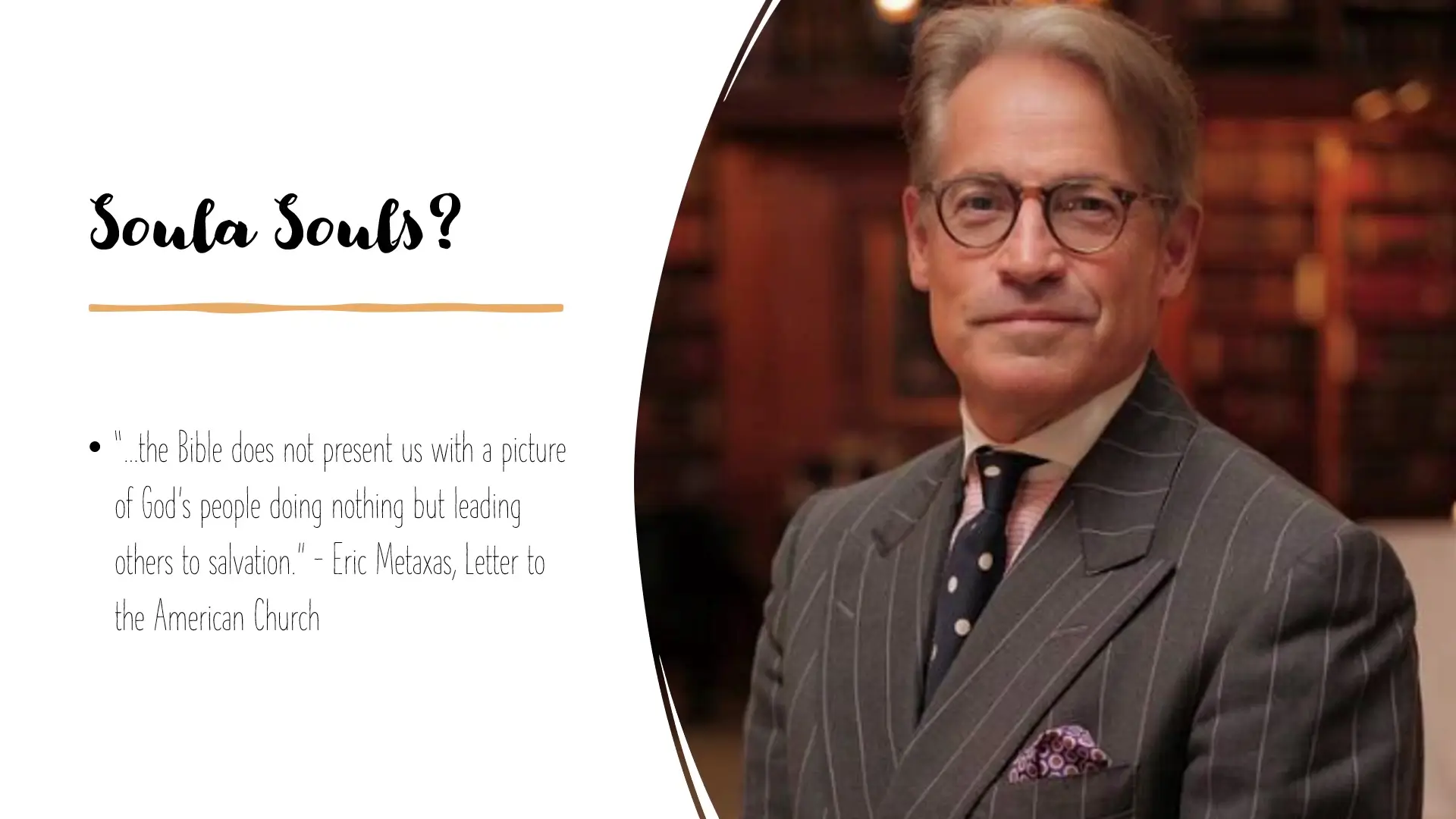
And Eric Metaxas is a hero of mine. I've drawn some inspiration from his book, Letter to the American Church. And he says, "The Bible doesn't present us with a picture of God's people doing nothing but leading others to salvation." So I've tried to hit that in the first chapter.
This is a little bit controversial. Most Christians and probably even a lot of just ordinary Australians think that when they die, they'll go to heaven or go somewhere. Many Christians think that they will become disembodied spirits in heaven and that's their eternal destiny. Your body just dies and that's it. I don't believe that and I don't think that's what the Bible teaches.
And I've been very influenced by a theologian by the name of Tom Wright, N.T. Wright, who is now a scholar at Oxford. He was former bishop in the Anglican church in the UK. He's written many, many books where he unpacks this from a theological point of view and points out from the Bible that the Christian hope is not to be disembodied spirits living in heaven forever. It's actually as resurrected beings on a renewed earth that has merged with heaven, the vision that we see in Revelation 21 for those who want to go and look it up. This idea that we die and go to Heaven. Now look, I think. Sorry, let me back up a bit. Wright says there's life after life after death. So when you die, I do believe that you go to Heaven.
I think that's right. I think when Jesus was on the cross and one of the thieves realised who this guy was said, Lord, can I be with you in glory? And he said, yes, today you will be with me in glory. So they were together after Jesus died, but that's not the eternal state. The Bible talks over and over again about the resurrection of the dead, and that's the ultimate hope of the Christian, that we will rise from the dead and live as eternal beings in a resurrected body.
How do we know this? Because Jesus rose from the dead and there was a physicality about his body. It was a body that had defeated death. Thomas, the doubting Thomas could touch his wounds and Jesus could make a barbecue of fish on the beach in the 40 days that he was on the earth after his resurrection and over 500 people saw him and then he ascended into heaven.
I believe that a man with a physical body sits at the right hand of the Father with obviously a body that's defeated death as Corinthians tells us. Now, I'm sorry if this is all very theological for a lot of people here, but the reason I labour this is for a lot of Christians, they think the world is just going to pass away and that all we have to do as Christians is get to heaven and get other people to heaven and that's it.
It doesn't really matter what happens to the world. It can get worse and we can go to hell basically. But for those who remember their Sunday school or any sort of Christian education, you'll know that the Lord's prayer that Jesus taught his disciples said, "Our father who art in heaven, hallowed be thy name, thy kingdom come, thy will be done on earth as it is in heaven." Jesus wasn't interested in getting people out of earth.
He was interested in bringing heaven to earth. And the job of the church is to disciple the nations and to bring heaven to earth. That's why Christians historically have run to the lepers, to the poor, to the sick, started the hospital, started the schools, tried to address the social problems. Christians have always been at the forefront historically of that. Why? Because they had a theology of bringing heaven to earth. I think we've lost sight of that.
My contention is that our politics has become a place where legislators are actually bringing hell to earth through really, really bad laws, economically and socially. I'm trying to say to the church, "Stop thinking about heaven. Let's start thinking about how we can bring heaven to earth rather than try to get out of here and leave this as a hellhole."
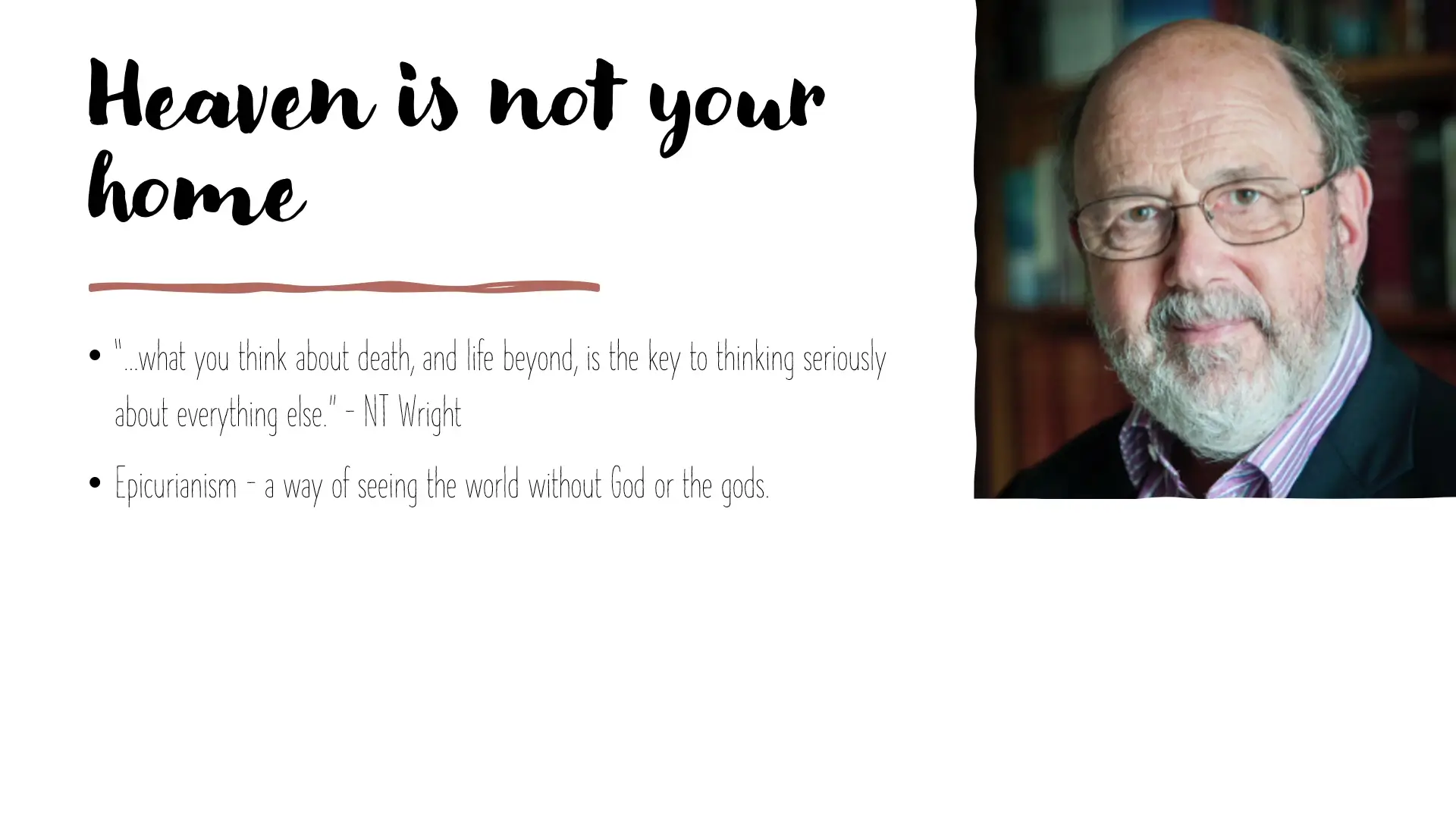
Wright picks up on some comments that really trace their origin back to the Greek philosophers, Plato and Aristotle.
"What you think about death and life beyond is the key to thinking seriously about everything else. "What he means by that is how you think it all ends up affects what you do now. And I think a lot of Christians think," Well, look, the world's just going to get worse and worse. I'm going to go to heaven and be with Jesus and it doesn't really matter what happens here. "I think that's given a lot of Christians a permission structure to stay out of politics. I won't unpack epicureanism. You can read the book for that. A lot of people say church and state are supposed to be separate. That's a common mantra and it's been used by particularly the left of politics in the last 40 or 50 years to try and bully Christians out of the public square. A couple of years ago, I picked up this book, Christianity and Constitutionalism.
Some of you will know Professor Nicaroni from the University of Queensland. He had this book published through Oxford University Press. It's a collection of essays by scholars who have traced Christianity's influence on the development of law and our political institutions. As I read this collection of essays, and I'm sure Scott Prasser can correct me on this, but it was so obvious that we wouldn't have a state in the way that we know it today with the Westminster system of parliament, a democracy, consent of the governed, rule of law, our legal system would not exist without Christian scholarship down through the ages forming and shaping this.
Now it's evolved over time. It was never totally perfect, but it was the Anglican Archbishop who wrote The Magna Carta, which the Barrons forced King John to sign when he was abusing power. On and on, you can see how Christians have helped address the abuse of power and how our parliamentary system has evolved to the point where we've got the freest America, Australia.
The Anglo-Sphere has got the best system of political government, I think in the world. It overshadows anything anyone else has got by any objective measure. Christians built that. Christian Scholarship built that. The idea that Christianity and the state should be separate is just a nonsense. I'd also take on the origin of that phrase, separation of church and state came from Thomas Jefferson when he was writing to the Connecticut Baptist in Danbury and they talked about a wall of separation of church and state, not because Christians shouldn't be involved in politics, but it was to protect the church from the state's incursion and that's the context of that.
So I've tried to, in the first three chapters, just provide a bit of a rationale from a theological perspective, very inadequate as to why we should be engaged. Then I sort of move into commentary on contemporary politics and failures of Christians in politics.
Two of our most high profile Christians to have risen to great heights to the very top of Australian politics was Kevin Rudd and Scott Morrison. And this chapter is called Christians in the Lodge Injustice in the Parliament. I'm sorry for being. I feel like I'm a bomb thrower, but as I looked at the prime ministerships of both of these two men, I can only come to that conclusion. And as a Christian, I feel embarrassed and I grieve that these men put themselves out there as Christians and didn't behave as Christians in the public square when they had high office. Kevin Rudd used to do his media conferences outside his church in Belimba here when he was running for prime minister and then outside the Anglican Church in Ainsley.
He wrote eloquently about Dietrich Bonhoeffer, the great Christian theologian, one of the few who defied Adolf Hitler and the Nazis and paid for it with his life. And so before he became Prime Minister, Rudd compared himself with Bonhoeffer, this great states, this man who would stand on principle. Unfortunately, Kevin Rudd was a bit like Groucho Marx. H said, "Yeah, I've got principles, but if you don't like them, I've got others."
And when it came to the marriage debate, that's exactly what Kevin Rudd did. And there's no more important issue in my thinking in terms of public policy than the issue of marriage between a man and a woman. And because Kevin wanted to be prime minister the second time after he'd been deposed, he knew that he couldn't become prime minister in the Labour Party because the ground had shifted and he had to cave in and support same-sex marriage, and that was a pretty sad day.
I've been in prayer meetings with Kevin Rudd. I've seen him pray. I have no doubt about the genuineness of his faith, but to see him throw principles like that out the window, particularly after writing long essays about Dietrich Bonhoeffer, I just don't know how you reconcile that in your mind.
And then Scott Morrison, I met Scott Morrison a few weeks before he entered parliament in 2007. I actually chaired a major candidate for him that ACL ran down in the shire in Cronulla where he was running and he was outstanding that night. He was clearly the best candidate on the night he got elected. He, in his maiden speech, talked about William Wilberforce, the great Christian parliamentarian of the 18th and 19th century who was instrumental in the abolition of slavery. I thought at the time, wow, we've got a guy who has just entered the parliament, is a public Christian, and he's saying that William Wilberforce, who abolished slavery at great personal cost, is now in the parliament and wants to model himself on that.
I though, wow, great times ahead. Unfortunately, we didn't see that. Then Scott eventually became prime minister, and look, I knew him through all that period. We had very good access to him in his office, and he loves God, he reads his Bible, he prays, but there's a disconnect in the way he practises his faith and his politics. It goes back to what I was saying before about the compact that the church entered into over the French enlightenment. Scott was one of these guys who put his Christian faith upstairs, and then downstairs, he would conduct politics like the best of the Machavellians, might is right.
I think that was a real shame. I guess one of my big disappointments is during the same-sex marriage campaign, I went and saw Scott at his office at the Commonwealth Parliamentary offices in Sydney. He was treasurer at the time, and he said, "I'm not going to campaign with you guys in the marriage campaign." We had a three-month campaign in front of us.
If you think of the voice referendum, it was that sort of dynamics. We couldn't find our Jacinta Price. We begged many prominent Australians to be our spokesperson. No one would do it. Then Scott, who was the most senior Christian in the cabinet of the day, Malcolm Turnbull's Prime Minister, Christopher Pine was there. They both supported the yes campaign in support of changing the definition of marriage. Scott wouldn't even be in the fight, and yet he'd held up William Wilberforce as his hero in his maiden speech just a few years earlier.
So there's a lot more I could say about Scott, and just so you think, "Well, that's great. You out there trashing Scott in your book." I actually felt quite convicted last year. I felt it was important to write this chapter, but I thought it was important to go and talk to Scott about the fact that I was doing this. I bumped into him at a function in Sydney last August and I said, "Can I come and see you?" We made an appointment and I went and saw him at his office in Macquarie Street overlooking Sydney Harbour. There's several ex-prime ministers with great officers looking over Sydney Harbour. We've had a lot of prime ministers in the last few years.
We had a good discussion for an hour. I left him with a hard copy of this chapter and I said, "Look, if you want to respond to any of this, I'd be very happy to put your side of the story, but I just want you to know I've written something that's critical of you." We had a robust but friendly discussion for an hour or so, and then he never got back to me.
I didn't feel that I had any. There was no obligation on my part to follow him up. I felt like I discharged my duty, but I really felt this needs to be told because for the next cohort of Christians who do enter politics, I want them to understand, I guess, some of the lessons of two men who the Christian church though were really going to carry the day for them and they were big disappointments and it's lots of lessons. I've got four chapters on my drag queen case.
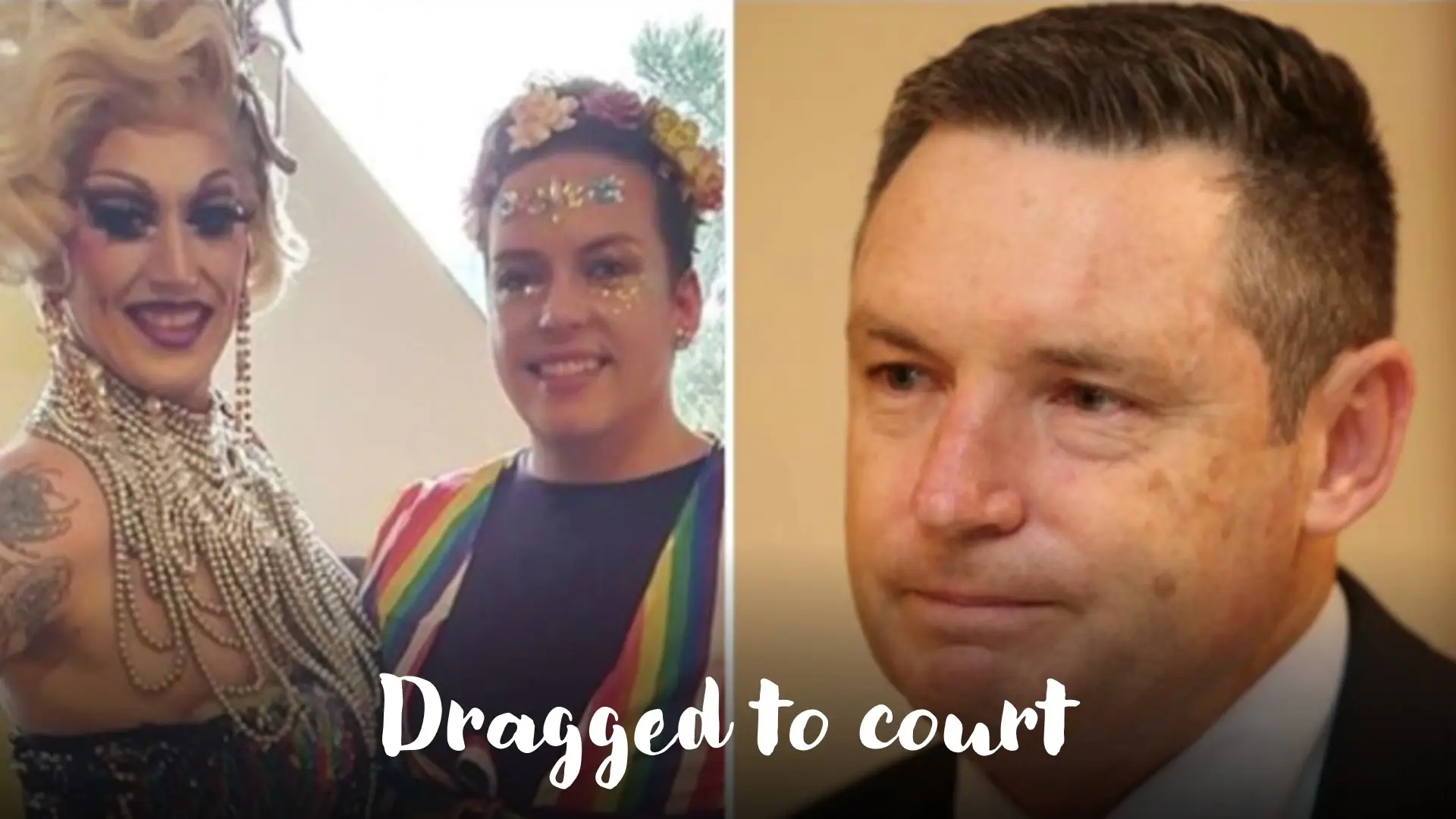
Some of you will know that in 2020, I was sued by two drag queens, Diamond Goodrim on your left and Johnny Valkery on the right.
We lived in Brisbane for three years at the time, and I saw this come through on my Facebook feed and there was a Drag Queen Story Time event at Brisbane City Council Library, and there was a protest going on, a group of young people from the University of Queensland Liberal National Club. I knew one of the young people that was involved in this protest. I saw the footage online and I though, gee, these guys are really brave. They just did a respectful protest. Yeah, it's a little bit edgy and a little bit out there, but they were right.
They went into that library chanting, drag queens are not for kids. Drag queens are not for kids. They're absolutely right. I just admired their courage. But then the next day, there was a big social media pile on Wilson Gavin, who was the leader of that protest.
He was an outstanding young leader, very well educated. He's only about 21.
The gay lobby just hit on him. Sally Rugg, who was one of the leaders of the same-sex marriage campaign, she made a particularly vicious attack on him. The next day, he went and threw himself under a train at Chelmer Railway Station here in Brisbane, and it was just horrible.
That really affected me, and I thought I need to say something about this. I just did a bit of Googling, which took me 30 seconds of these two drag queens, and I realised what these kids were protesting really needed to be brought to public attention.
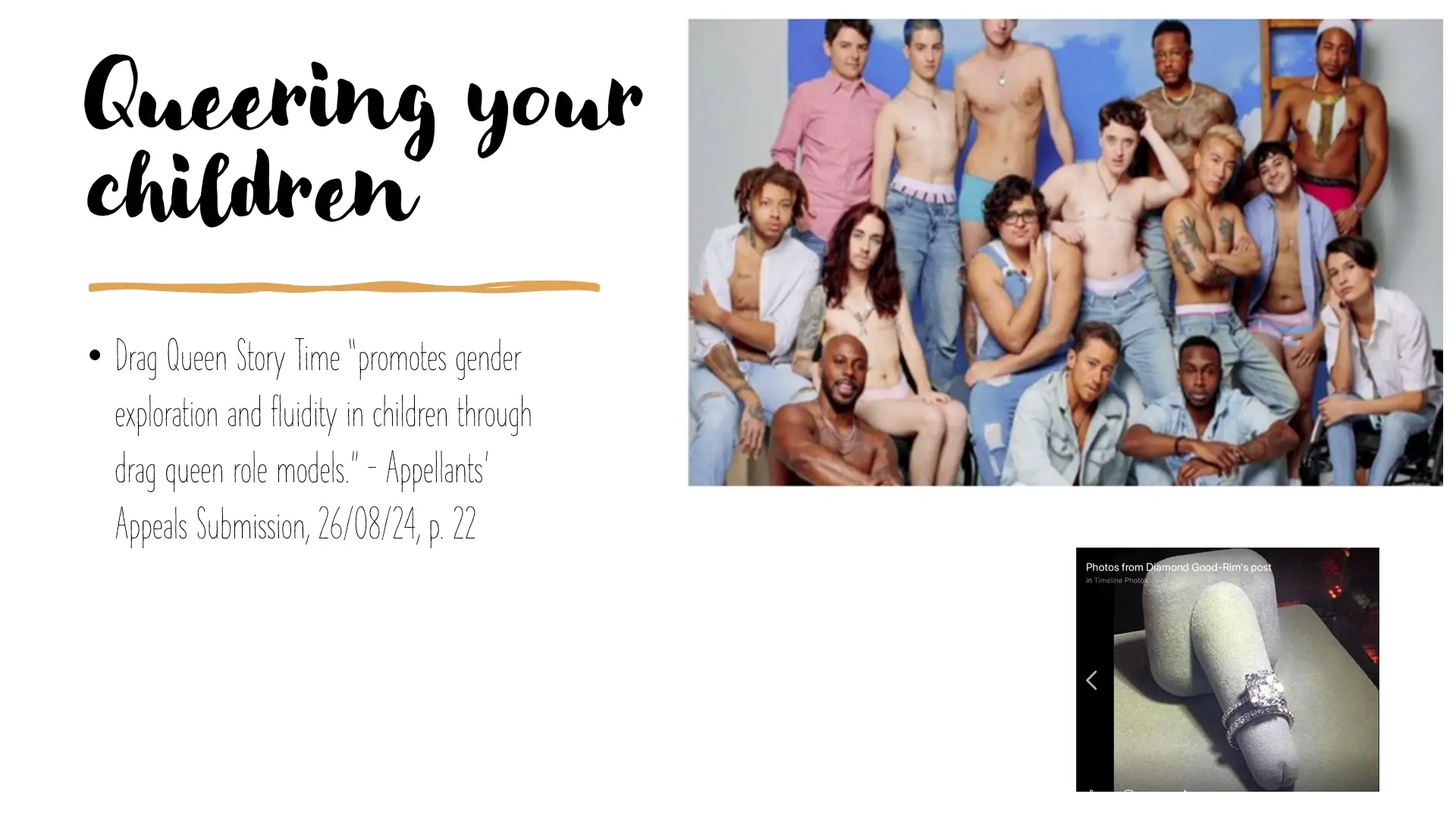
I looked on their Facebook pages, and I apologise for the lured image at the bottom there, but this top image was from Johnny Valkery's page. Johnny Valkery is a woman, and at the time was crowdfunding on her Facebook page so that she could have her breasts removed so that she could present as a man.
And this image was there as part of that. It's an image of a whole bunch of topless young women who have had their breasts surgically removed, and you can see their scars. That is horrific and confronting.
She's promoting gender fluid ideology, and she actually, since then, has gone through with a double mastectomy of her own and tries to present as a man.
The other fellow, Diamond Goodrim, is a bog standard drag queen. Diamond Goodrim, don't Google "Goodrim", but on his Facebook page, he had this lurid image and he was proudly displaying an award he'd won from the pornography industry. I just though, "Okay, there's been a protest. A young man has had a social media pile and he's taken his own life. People need to know about this stuff."
I wrote a blog, that's all I had at the time. I was in between jobs and stuff, and so I put this on my blog and I said, "Dwayne Hill and Johnny Valkery are dangerous role models for children." Then some concerned parents sent me some other imagery of drag queens, so I wrote some more blogs.
So this was January 2020, and then by May 2020, I received in the mail a letter from the Queensland Human Right Commission compelling me to go to compulsory mediation because they said that I had most likely breached the Anti-Discrimination Act, which you're not allowed to incite ridicule or hatred of people with certain protected attributes and your sexual identity and your gender identity. Protected attributes under Queensland law. So we had to go to this mediation.
The mediation was basically, "Okay, Lyle, you apologise and pull down your blogs." Well, I said, "Well, look, with respect guys, I'm not going to do that. I have no animus against you." And we were very polite to the drag queens, but said, "Look, this is an issue of public policy debate. I'm not going to pull down my blogs." So the mediation in the Human Rights Commission failed, and then a few months later they sued me in the Queensland Civil and Administrative Tribunal.
And we've been engaged in litigation for the last six years. We're now into our seventh year of litigation. It finally went to a trial in November of 2022, three-day trial here in the tribunal. We won that. A year later, I got a judgement completely vindicating me. It took a year. And then they appealed.
So by 2024, I was back in the tribunal for three days of appeal hearings. And it looks like we've partially lost the appeal. We're not fully, but we've had a setback and we're now back in the tribunal. My lawyers filed final submissions from our side just last week, and the other side filed their submissions yesterday. We're probably going to get a judgement sometime in the next few months. But I expect we're probably going to lose, which means we'll be appealing to the Queensland Supreme Court and probably ultimately to the high court.
But it's cost $500,000 so far, at least, at least, as well as six years.
Now, people in Australia think that we have freedom of speech. We do not have freedom of speech. And look, I knew that these laws were a problem during my time at ACL. We knew that they were a massive vulnerability. And we tried to warn people during the same-sex marriage campaign, if you degender marriage, you're going to get a lot more of these anti-free speech court cases.
And it's not just me, Jasmine Sussex, the breastfeeding. She's not a Christian, she's just a midwife who, sorry, a lactation consultant helping women breastfeed. She said men can't breastfeed. And so they sacked her and she's involved in litigation as well.
My friend Kirralie Smith, who said that men shouldn't be playing against women in soccer, in women's competitions. She's had $95,000 in damages awarded against her.
Sall Grover, who spoke at my conference last Friday night, the Giggle v. Tickle case, I'll come to that in a moment. It goes on and on. I'm not the only one.
And it drives me nuts that politicians are not speaking up about any of this. I mean, I'm just filled with contempt for our politicians. I hope it's a righteous contempt, but they go along to Anzac Day where we venerate those who fought for our freedoms and they won't even fight for the basic freedom of speech in Australia anymore.
My great uncle didn't die at Gallipoli so that drag queens could take you through the courts because you've hurt their feelings. But that's where we are as a nation.
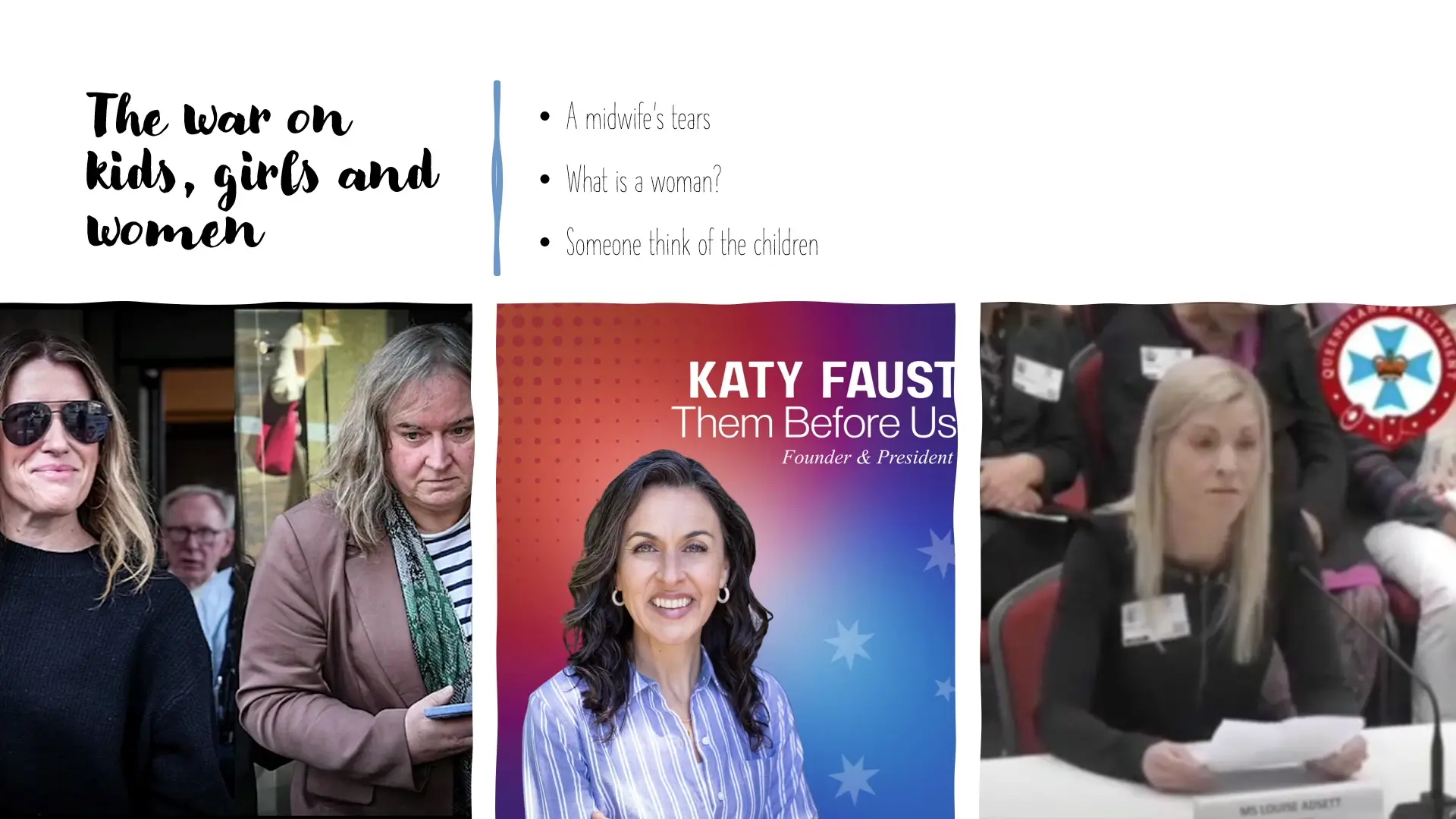
So there's four chapters on that. I mentioned Giggle v. Tickle, that's Sall Grover there. And Roxanne Tickle is a man who wanted to be part of the application that she set up, a smartphone application to create a private space for women and girls.
It's called Giggle for Girls. Roxanne Tickle, Giggle v. Tickle. You can't make this stuff up. But it's been suggested that Roxanne Tickle, who I say is a biological male, should change his name to Tess.
Now, when you can ridicule something so easily, just goes to how ridiculous this is from a public policy point of view. Now, I don't want to be mean to Roxanne Tickle. I've seen him in person, but the idea that men can identify as women and demand that they can be in their sports, in their private spaces or in the toilet with my daughter or your granddaughter, that is just not on.
But this is what this ideology and this political movement is demanding. And whatever issues. I'm a Christian. I believe everyone is created in the image and likeness of God and has dignity. And I don't mean to demean Roxanne Tickle's dignity, but I think it is appropriate to have a bit of a joke at the absurdity of what he and the political lobby behind him are demanding that the rest of us comply with.
So I cover the what is a woman controversy in the book. I also cover the issue about what's happening to children in our society.
And this woman in the middle, Katie Faust, she actually spoke live via video link at our conference on Saturday from Seattle where she's based. It was 25 minutes of the most powerful excoriation of what we are doing to children in this country from abortion through to surrogacy, IVF, some controversial topics, but she makes a compelling case that we are really putting the rights of children last in public policy because of the selfish desires of adults.
And so I summarise her book Child Centred Politics, so there's a bit on that.
The woman on the far left, your right, is Louise Adsett. In fact, I'll be at her place tomorrow night. We're doing a book launch up in Nambour. Her and her husband are having us for dinner, which is very nice, but she's one of the most courageous people in this nation.
Two years ago, she as a midwife at a large hospital here in Southeast Queensland presented at a parliamentary inquiry on the issue of babies being born alive after late-term abortions. There's about a hundred or more of these per year in Australia where babies survive late term abortion post 24 weeks. She described a baby living for five hours gasping and crying and they weren't allowed to do anything to support this baby. It's a very common occurrence.
It's not thousands, it's in the hundreds, but it shouldn't occur. I mean, no baby should be killed in their mother's womb, full stop. But this is the dirty secret of the abortion industry, which people need to know about. So when Louise turned up at this parliamentary inquiry and presented and described this, she broke down in tears as anyone with a heart would. And this was in 2024, two years ago.
I just thought at the time, surely this is going to break open at least a sensible discussion about what we're doing to unborn babies in this country. But no, it didn't. Our politicians are callous, they're harsh. And David Crusafeli, who's your premier, has got a record number of Christians in his party room, has imposed a gag upon all of his parliamentarians from talking about abortion in the Queensland Parliament.
The idea of a Westminster Democratic Parliament is for freedom of speech, absolute freedom of speech to the point where you have privilege. You can defame anyone in parliament and get away with it, but Crucifelli has demanded that his people cannot talk about human rights, cannot talk about Louise's issue because they don't want to talk about this. And unfortunately to the shame of the Christians, many of them who I know personally and contacted over this have gone along with it.
I'm just deeply shocked, but it says something about where we are as a society and a culture. I think sadly it goes to the fact that most ordinary Australians actually do support abortion. They support abortion in the earlier terms.
Polling shows that people have woken up to late term abortion. They don't support that, but people are very confused. There's cognitive dissonance going on, and I think the more we can get a discussion going, I think people will come around to being rational about human life.
We're in a dire state. So again, I wanted to chronicle that and put it on the record because I think it's easily forgotten as it has been forgotten. This issue is a standalone chapter and I've been concerned for a long time about Islam. I just thought that Muslim people, once two or three generations, they'd just become Aussies like the rest of us and enjoy Australia. And that was my naive hope. You want to believe the best about people. And look, we've all met Muslim people. They're lovely people. Most of them are very lovely people. I've had the privilege of meeting Dr. Ali Khadri, who is the head of the Islamic school here in Brisbane. I've had dinner with him, had coffee with him the other day. We don't agree. We debate these issues, but at least I value the fact that at least we can talk and I think we need to talk.
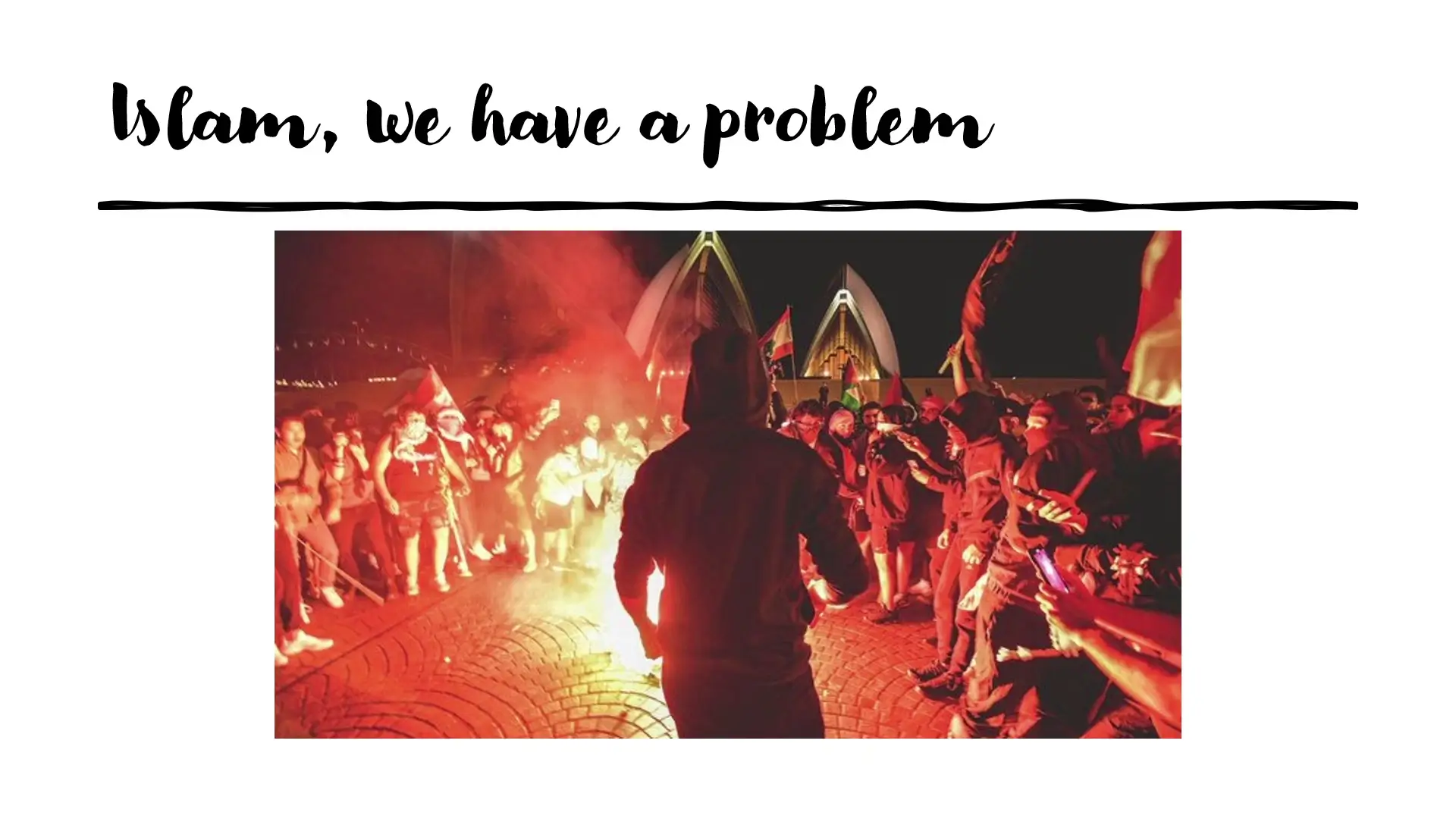
But since October seven, 2023, when this mob of Muslims from Western Sydney went to the forecourt of the opera house, not far from where I live, about 10 kilometres from where I live, and started letting off flares and chanting, "Gas the Jews, F the Jews." I mean, I was shocked. I was shocked. I mean, the bodies of the women and the people that were killed, the women raped, people slaughtered in their homes, babies, old women, 200 hostages taken back into Gaza and. It's pretty clear who the good guys are and who the bad guys are.
Whatever you might think of Israeli politics or whether the IDF are a bit heavy-handed, if this happened to Australia, I would expect a very severe military response to the perpetrators of this. But what we've seen over the last three years is a complete moral inversion where the radical left of our politics and Muslim leaders in our major cities have bantered together and have made Hamas the good guys and Israel the bad guys.
I mean, the mind just boggles. And I'm very, very concerned because I've documented at least 27 instances of Muslim leaders in Western Sydney since October seven saying things about killing Jews. Wissam Hadid, the fellow who said after the Hamas slaughter, "I'm elated, I'm smiling," and there's a whole bunch of Muslims in Western Sydney yelling Ella Akbar.
I'm thinking, "This is not Australia. How do these people not see? You don't have to like Israel, but at least have some common decency for humanity." So it's a real, real worry.
La Quemba Mosque, which is the biggest mosque in Australia, again, not that far from where I live, on the anniversary, the first anniversary of October seven, held a rally outside Le Kemba Mosque hosted by Hisbat Alteria. They are a terrorist organisation banned in most Muslim countries. They're only banned in Australia earlier this year after a lot of pressure on the Albanese government to do it.
I always though the problem was radical Islam, but when a moderate mosque, a mosque which is supposed to be a bastion of moderate Islam, hosts a terrorist organisation, we have to be asking questions about what's going on here.
Now I'm about to show you a video. What's current at the moment is the Le Kemba Mosque has an application before the Canterbury Bankstown City Council. It's a development application to broadcast the Muslim called a prayer, the Adurn, the Adan. And the Adan is Allah Akbar, God is great, come to Allah for success, et cetera, et cetera. These two young fellows that I've got to know, one of who does a lot of my social media videography and stuff like this, they are quite fearless. One of them is a son of Christian Marinite parents from Lebanon who saw Lebanon destroyed by Islam in their lifetime. I mean, look at what happened through the 1980s.
Lebanon went from being the Paris of the Mediterranean to the hell hole of the Mediterranean. And because Muslim domination and kicked all the Christians out, it's just become a mess. And so Marinites in Australia, particularly and Chaldeans, anyone who's lived in the Middle East is very worried about the agenda of Islam in Australia, and I think we should be too. So just watch this video.
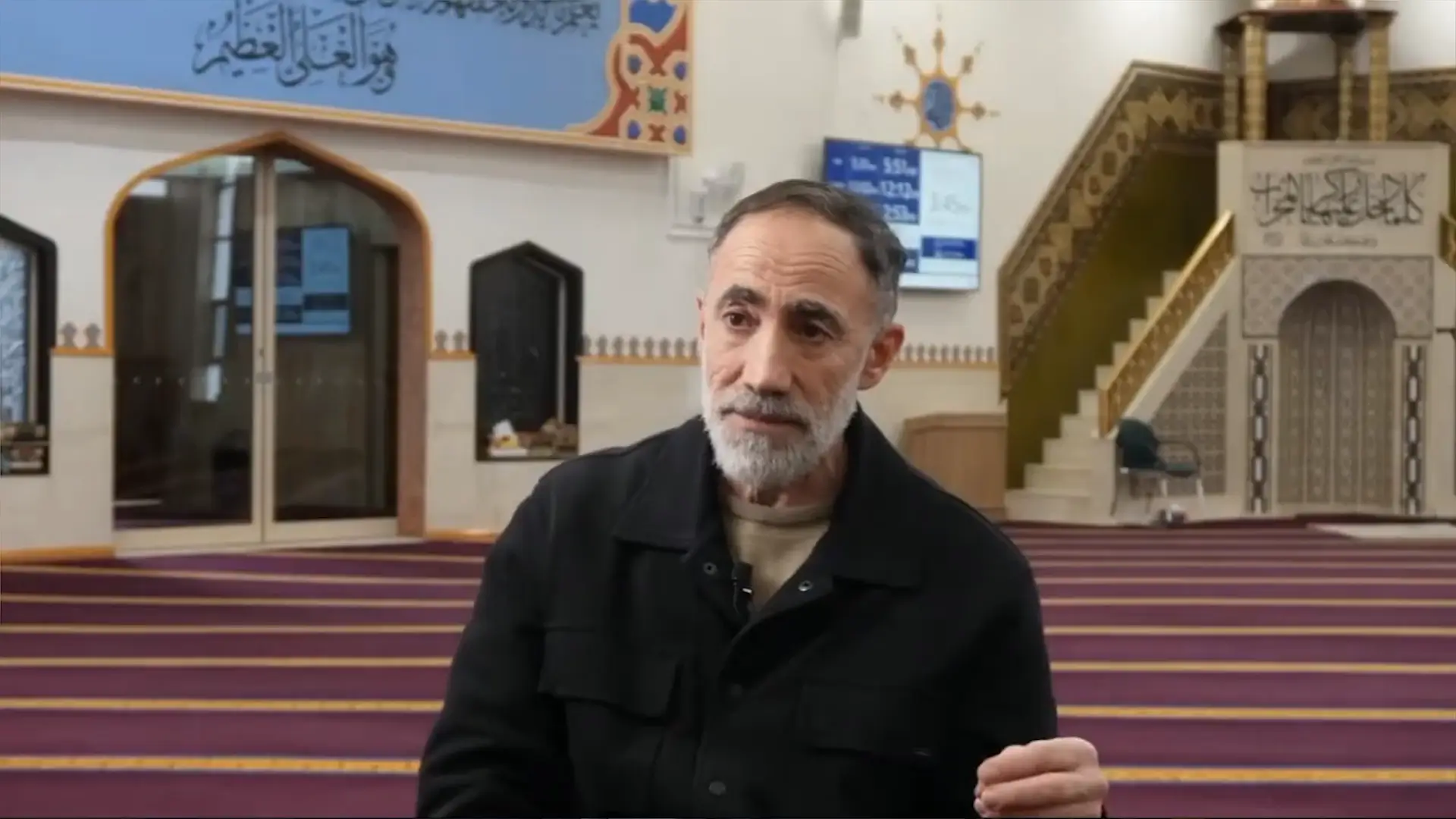
Interviewer:
So many people, they link their hand to the conquering of when Muhammad would conquer an area and then they Adhan would play and they would mark that this is Muslim territory now under Muslim Christian.
Gamal Kier:
Again, that is historically factually incorrect. The call to prayer was actually given as a call to say that we are here. See, again, hand in hand with that perception is the fact that the belief that Islam was spread by the sword, which historically, if you looked at the facts, it wasn't. So when we're talking to Prophet Muhammad, peace be upon him when he went to another territory, traditionally what would happen was the people of that city or town or village or whatever the case may be, would be given three options.
The call to prayer, which means they've accepted the Islamic faith because they'd say the call to pray and they would reply the call to pray. So it's not a call to pray saying we've dominated, these are ours now. They would call the prayer. If the inhabitants of the city returned that call, then that's a sign saying we've accepted.
If they didn't want to accept, they don't return the call to pray, they either lay down their arms and pay a tax. And if they didn't want to do these two, then there wasn't a call to pray, it was a war.
Lyle Shelton:
Okay. Did you hear that? Now there was a bunch of contradictions in what he said there. So let me just unpack it for you.
That was filmed about two months ago inside Le Kemba Mosque. That man's name is Gamal Kier. He's the spokesman for the Lebanese Muslim Association, has a very high media profile. He's very articulate as you can see. But he started off that little piece saying it's historically inaccurate that Islam spread by the sword.
Anyone who knows anything about Islam knows that that is demonstrably untrue. Muhammad went into Medina slitting the throats of Jews. That's how Islam started. Jesus rode a donkey into Jerusalem and gave his life on a cross. That's the difference between the founders of the two religions. Islam is a religion spread by the sword. I mean, that's how they conquered most of Europe and got to the gates of Vienna.
It's always been thus. So for him to say that, that's just a lie with respect to Gamal Kia. I think you can objectively say that. And then when asked about the Adan, he said, "Okay, well, Muhammad and the Muslim armies, they'd go to a town, they'd put out the call to prayer. If they accepted, they become Muslim and everything's fine if you convert.
Number two, you pay the tax, the GZA, and then you come under our protection. So if you don't convert, well, that's fine. You can still live, but you've got to pay the tax to us.
Number three, war. He said that out loud on camera. And I asked young Abe, the Marinite fellow who was asking the question, who knows a lot about Islam because his parents are from the Middle East and he studied it and read the Quran. He said," I don't think that guy meant to say that.
I think he slipped up. They think he actually slipped up because that is actually what Islam teaches, and he just said it out loud on camera.
Now, I transcribed that and sent it to every media outlet in New South Wales and got absolutely zero pickup, but I think that is a very, very big story. And look, I'm going to keep pushing that. I think people need to know.
So at the moment, the Canterbury Bankstown City Council is stalling Le Kemba Moss trying to find town planning grounds to stop it. But I think they'll keep applying because if they get this through, as the Liverpool City Council has said, Liverpool will be next. Every mosque in Australia will want to broadcast the Adan.
Now you might say, well, isn't that just religious freedom? You have church bells, yada yada. The Yadan is a broadcast of Muslim dogma. A church bell is not that, and most churches don't have church bells anymore anyway these days. It's mainly in the inner cities and most don't want them, but churches don't broadcast dogma on megaphones into the suburbs.
I think it needs to be opposed on these grounds, on the grounds of cultural cohesion. I think we've got to start saying, look, no one wants to stop you from being Muslim and practising your religion, but this is a country that was founded on Judea Christian values. That's what's made Australia what it is. We want to keep our ethos here and not have it cult dominated, particularly if that's what the real agenda is.
Move on from Islam. I'll skip through. I know time's getting away. I've got a chapter on Christian schools. I had the privilege of being educated in a Christian school and some of my teachers are here from those days.
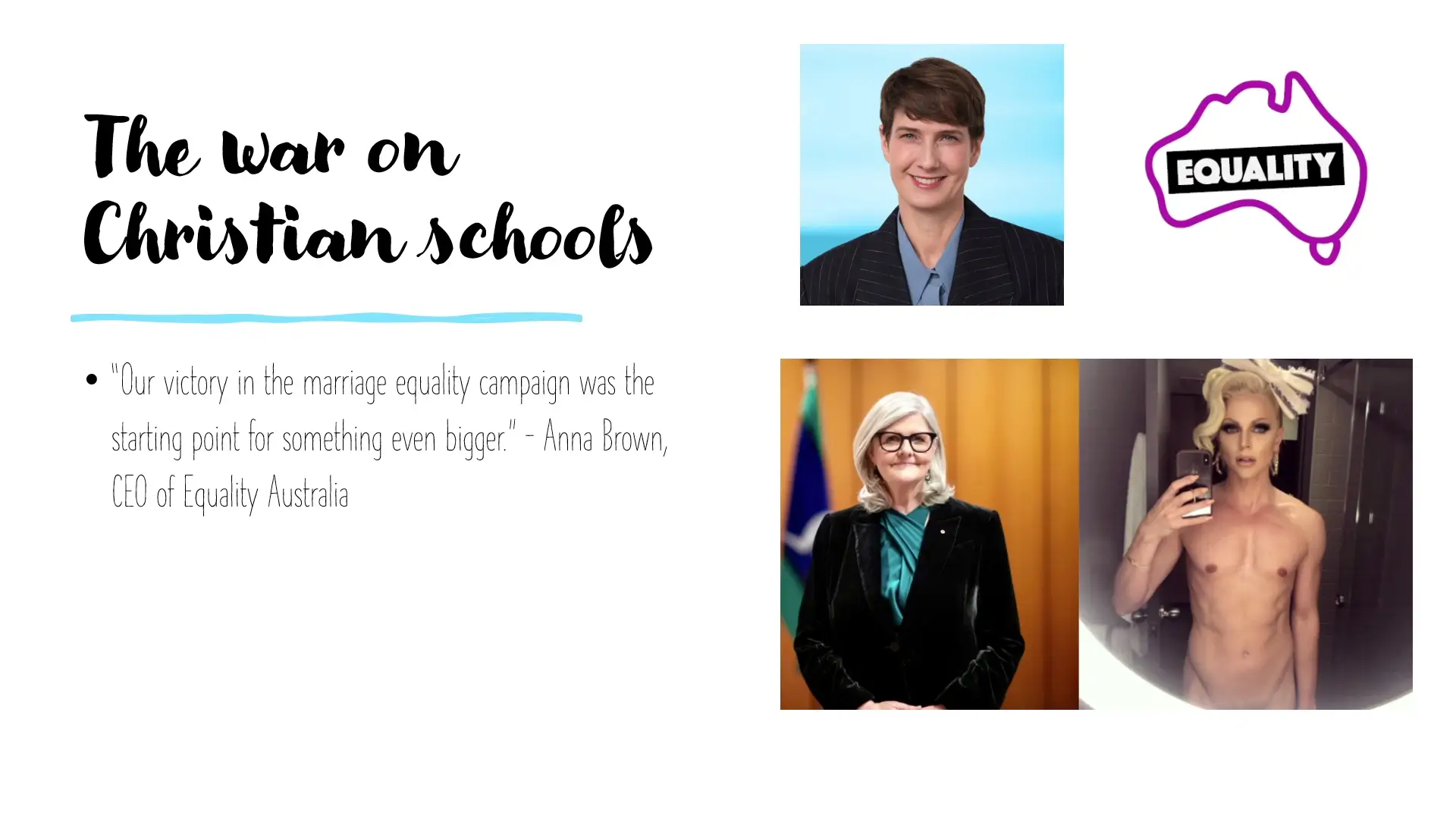
But since marriage was redefined in law, the Australian Marriage Equality Group, which was the YES campaigners, they didn't go away. The radical left never stop. They don't stop. They just rebranded after they won in 2017, called themselves Equality Australia.
That woman at the top there is Anna Brown. She was one of the leaders of the 2017 YES campaign. The first thing she did was go after Christian schools. They launched litigation against Ballarat Christian College. They got big city law firm, Clayton Utz involved to intimidate their board. Scott's been involved in this through his work, but they have been trying to take away the freedom of Christian schools to employ staff who share their ethos. That is staff who believe that marriage is between a man and a woman. People can disagree in a democracy about what they think the definition of marriage is, but a Christian school should be allowed to employ staff and preference staff in employment who believe that.
And they should be able to require that kids who go to those schools conform to an enrollment policy that accepts that, that accepts that boys and girls are girls and that we're not going to allow biological males to play netball with the girls or be in their change rooms or sleep in their dorms at the school camps. It's just not going to happen because we believe that gender is binary and that marriage is between a man and a woman.
This outfit Equality Australia is relentlessly at this very moment trying to strip those freedoms from legislation. There's a stalemate at the moment, but they won't rest. Now, I put these other two characters up there because I think we need to know who our enemies are. The Governor General Sam Moston is the patron of Equality Australia. The Governor General is supposed to be above politics.
This is a political lobby group. The other fellow next to Sam Moston is a man called Shane Jennick who has a drag queen persona by the name of Courtniak. He's quite lured and disgusting, but he's the co-patron. I just think none of this passes the pub test.
Again, I've written to the Governor General's office. I've got a nothing reply. They know that we keep putting this out on social media. It's quite fun, but people need to know this sort of stuff. This is serious. If you believe in freedom of association, which the freedom to associate with people you want to and create communities, whether it's religious or otherwise, you should be allowed to do that. But we've lost those freedoms in Australia.
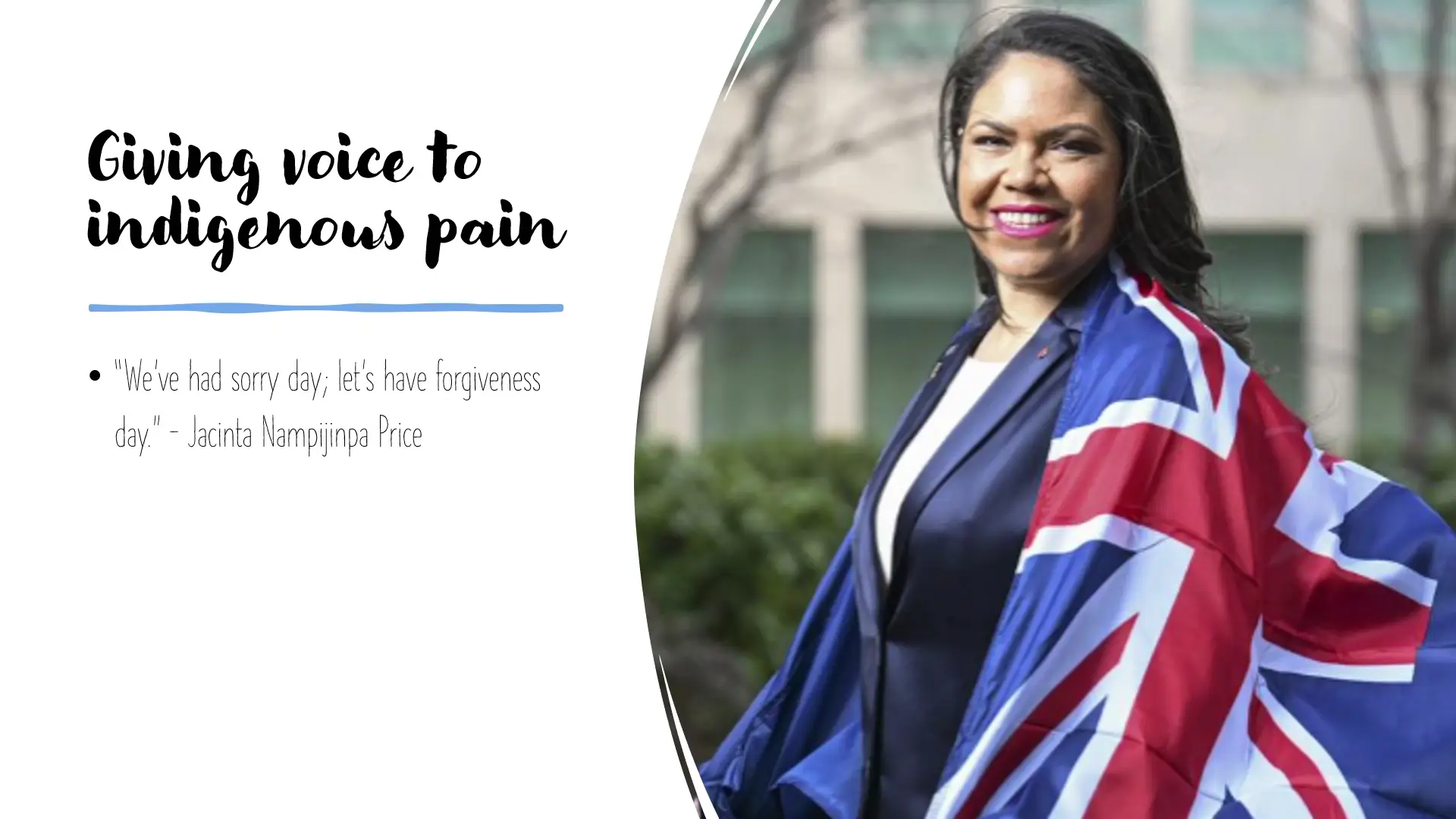
I've got a chapter on indigenous issues. Jacinta Nampagina Price is I'm sure a hero to all of us here. She says, "We've had sorry day. Let's have forgiveness day." And I think that's a good approach. It doesn't mean we gloss over the- And she certainly doesn't gloss over the hardships she's from Alice Springs, but we've got to stop the victim mentality.
I've got a chapter on the net zero issue. I'm sure there's no one in this room who thinks that we should run the economy on windmills and solar panels. And the evidence is just overwhelming from many different quarters that it doesn't work.
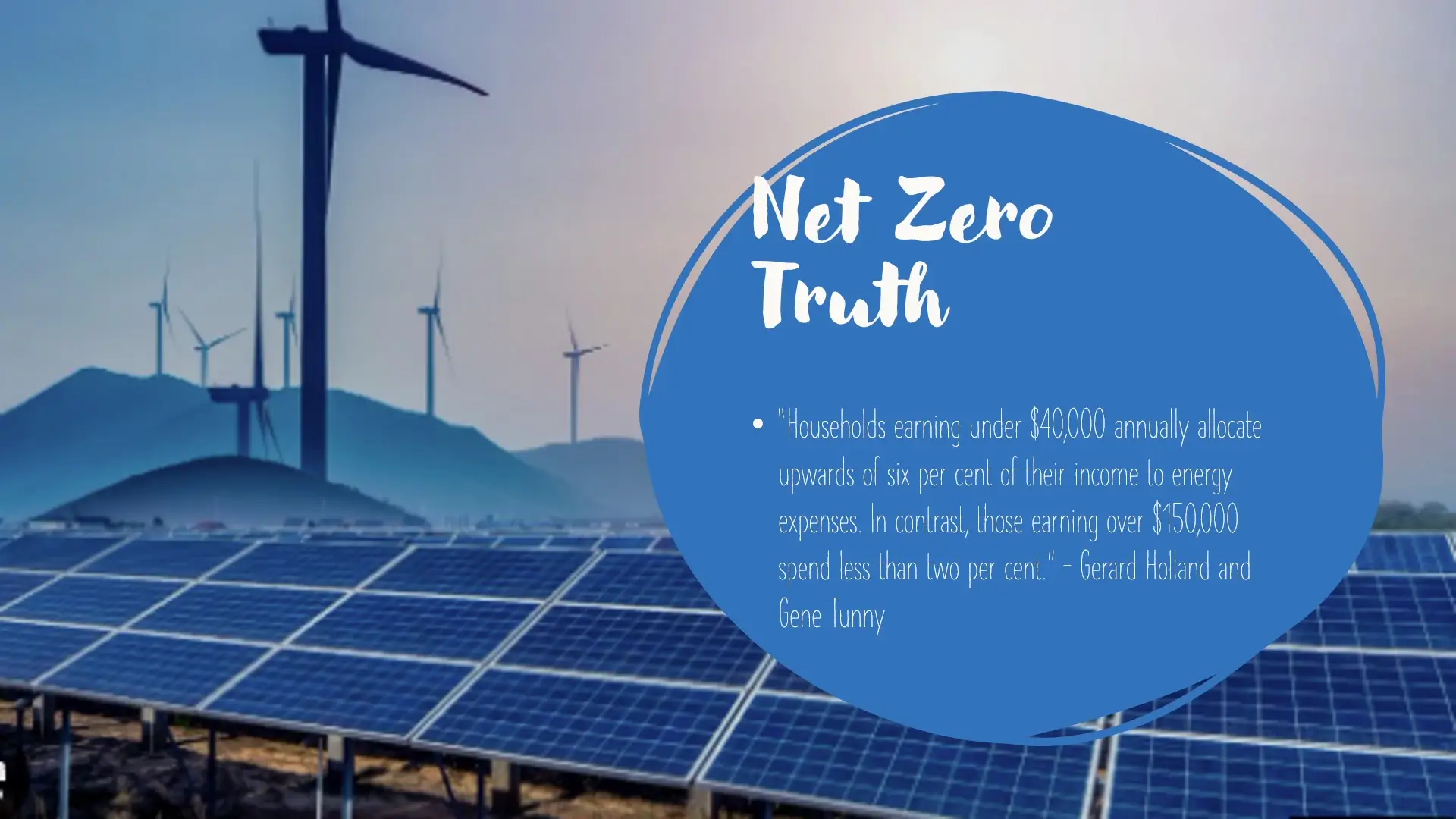
The Germans are retreating at a great rate of knots. As I say, America's not doing it anymore. Well, you'd say Trump's doing that, but even the left-wing Germans, and it's wrecking our country. It's wrecking our country. And this is a really important quote because it talks about how net zero punishes those who can least afford it. It's a luxury belief.
The people on the North Shore near where I live, they're all driving the Teslas around. They hardly notice a few hundred extra bucks on their electricity bill, but people out in Western Sydney do, and people trying to run businesses and manufacturing do, and we are just destroying our economy for no reason.
I've got a whole bunch of other chapters there. I won't go through all that. I've got a chapter just on how Family First, Mark two, as we call it, got going again back in 2021.
And then I've got this chapter on Charlie Kirk and George Pell.
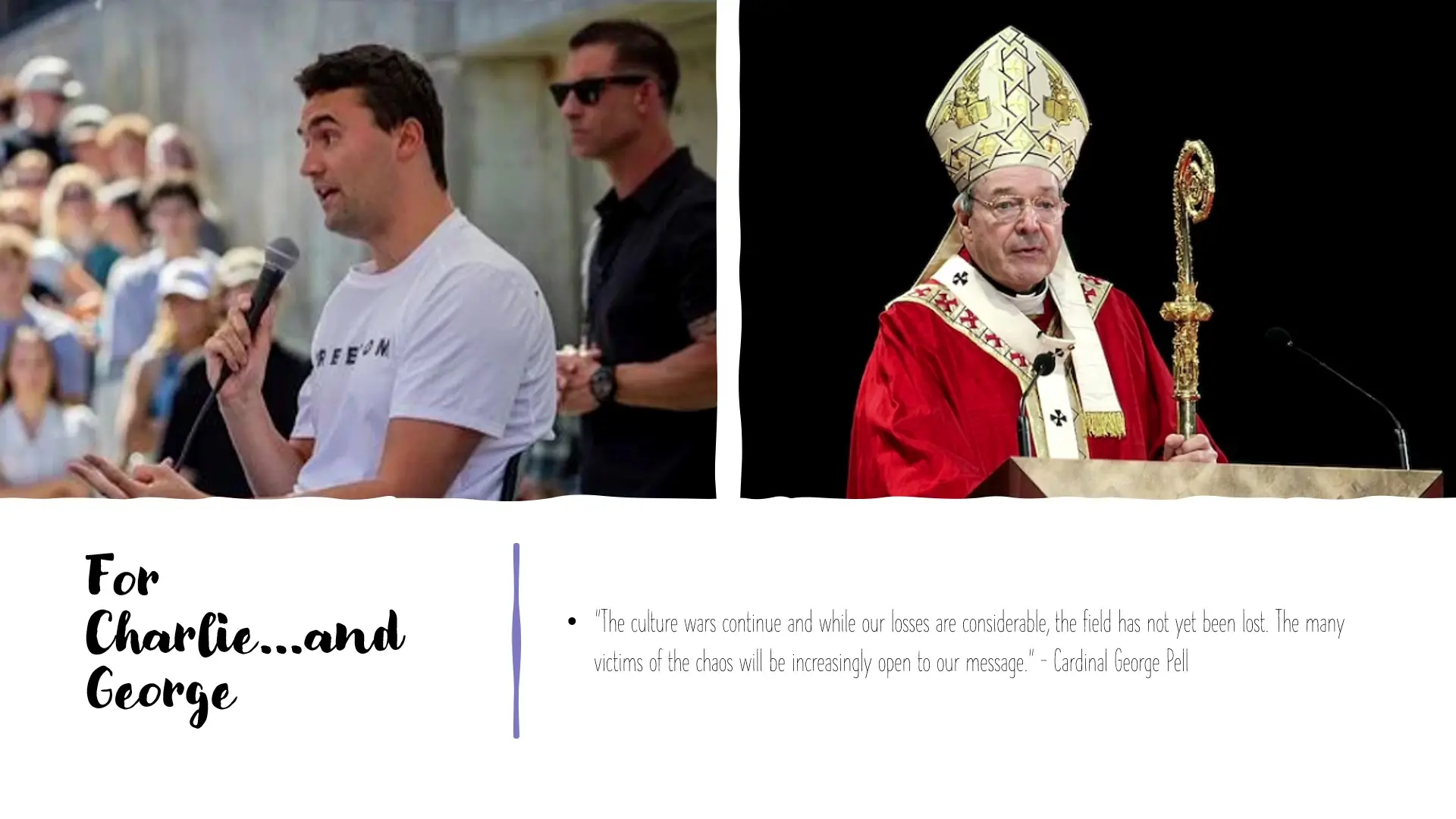
Charlie Kirk, someone I'm sure we've all heard of. I'd obviously heard of him or listened to him on some podcasts, greatly admired him, didn't really know that much about him, knew he'd been influential in mobilising young people for the MAGA cause, and I knew that he was a good guy, and he was someone who was willing to engage in debate with people whom he disagreed with, something that we don't do very well these days.
When he was shot almost a year ago, that really affected me deeply. I didn't expect it to happen. My social media started blowing up. It was early in the morning and lots of people cut Charlie Kirk's been shot, watched the news, saw the brutality of what had happened. Someone put the footage on YouTube. I can't unsee it.
But the fact that someone who believes the sort of things that I believe and that all of us believe really affected me deeply. I talked to many of my friends in this space and we all felt the same. It took me weeks to emotionally process this. I didn't expect it.
I think it's because someone who did what many of us are trying to do far less eloquently was killed for what we all believe in was deeply shocking. He was killed by a trans activist and that was very impacting. But then it got me thinking about Australia's own martyr for the issues of life, family, marriage, faith, freedom, and that's Cardinal George Pell. He died a couple of years ago of natural causes, but before he died, he had been a very outspoken church leader on all of the issues that I've been talking about tonight and more, and incredibly intelligent, incredibly articulate.
The left hated him for it.
He was demonised for years, for decades. They were always attacking him in the media. They always made him as some weirdo Christian guy in a dress. Eventually he was so effective, they had to try and find a way to bring him down.
The Victorian police, judiciary, and I believe politics conspired to trump up child sex charges against him, and he went through a trial and then an appeal, and he was put in jail, and he spent 400 days in solitary confinement for crimes that he did not commit. Eventually, the appeal went to the High Court of Australia.
The High Court isn't necessarily a conservative. It's not necessarily a group of conservative judges. There's some conservative, some not, but they were good enough jurists to realise when they went through all the evidence that this was an absolute crock. And he was exonerated seven nil. Not many high court judgments are seven nil.
It was overwhelming. It embarrassed obviously the Victoria Police and their judiciary down there, and there should be an investigation into how this happened.
But George Pell copped this with great grace and humility. His prison journals are incredible. He's not bitter. He was never bitter. He obviously felt the injustice of it. After he got out of prison, six months before he died, my wife and I had the opportunity to be at a dinner at the New South Wales Parliament house where he was speaking, and he gave an incredible speech, again, about a lot of the stuff we're talking about tonight, the state of Australia, the economy, the social issues, the pro-life stuff. He was so eloquent and so good at presenting the case for conservative Christian values.
Peter Dutton was there that night sitting in the front row. It was before the last election, and I just thought if only Peter Dutton had the courage to pick up some of these issues and run with them, he might have been prime minister.
I mean, he squibbed the gender issue, he squibbed the women in sports issue during the election campaign. How hard is it? I mean, ordinary Australians know what a woman is, and if only a leader would say it, they'd go hallelujah. But Dutton didn't have the courage, even though a few months earlier he'd been sitting there listening to the great Cardinal Pell.
I took some notes that night and got some notes from the Catholic press that covered the speech. I've reproduced some of the great things he said in the book, and I'd really encourage you to read that chapter because he says it well and he's a man of great wisdom.
Then I went to his funeral, St. Mary's Cathedral in Sydney was packed out, and that was an amazing day. Tony Abbott gave the most incredible speech I've ever heard him give, and Cardinal Pell's brother, David, spoke, and it was just incredible.
There was a whole bunch of LGBT political activists outside yelling and screaming the whole time and calling him a paedophile and all this ridiculous stuff. It was just awful. But he's a great man, and I believe he deserves an honoured place in Australian public life, so that's my little attempt at a tribute.
I think there's other stuff in the book, Jewel, and I've probably talked for way too long, but my hope is that this will provoke a conversation, particularly amongst Christian people who are really missing in action.
I'll perhaps just finish with this, Jewel. I'm so concerned for our nation, and I know all of you are too. By any measure, we are going backwards at a great rate of knots. I have felt that for decades. That's why I've been involved in activism for the best part of 30 years. But in more recent times, when people like John Anderson, former deputy prime minister, who's one of my heroes, when he says that our nation is in peril, a mild-mannered person who's not prone to hyperbole, but as he analyses the nation and listen to his podcast, when smarter people than me are saying this, I think we need to take notice.
By any measure, we are in deep trouble. I believe we are teetering on the brink and we could go either way.
History shows that all the indicators of civilizational decline are with us now, a breakdown in morality, a breakdown in the economy, all of these things are coalescing, the lack of truth, our inability to reason, all of these things, all of the ingredients that are needed for a civil society have been trashed. Our Western inheritance is being trashed before our eyes because of the long march of cultural Marxism through our institutions. I think we've got to wake up very quickly. I think it can be recovered, but I'm not sure it can.
I've been reading a book. I read a book about four years ago on leadership by Henry Kissinger, and I know he's a controversial figure, but he actually personally knew several world leaders in the post-war era. And he talks about six of them, but two in particular I'll mention very briefly in closing.
Conrad Adenau was the first chancellor of Germany after World War II, and he had to pick up the pieces of a shattered nation. They were disgraced because of the Holocaust, what they'd done to the Jews, what they'd done in dragging the world into the bloodiest war ever. They were a completely humiliated people, and Adenau was one of the few people who did resist Hitler during the war. He found refuge in a Benedictine monastery and read papal and cyclicals while he was there, and that prepared him for what was to come after the war.
He founded the Christian Democratic Party, and he said to his people at the time, "As we come out of it, we have to be humble, we have to repent of what we've done, and we mustn't be seeking a political identity, but we've got to seek a Christian identity." That's what he said, and this is Kissinger recounting this. I thought that's very insightful.
Australia's in no way near the mess that Germany was post-war, of course, but these were the principles that he's embraced as he led his nation out of the ashes. There's a cry going up in our nation at the moment. We want our country back.
Many of you like me have gone to the marches for Australia. The Pauline Hanson phenomenon is the political expression of that cry. We want our country back. I had the privilege of speaking at one of these marches in Canberra in May, and my message was.
And look, I share the concern about too much immigration. I don't think we should stop immigration. I think we need to manage it well, and I think we need to make sure the people who come in share our values, of course, and that means no Sharia law. But I think the issue is bigger than immigration.
The cry, we want our nation back, what does that mean? Well, it means that in the past, there was something good about Australia that resonates with us all, particularly those of us, and we're in the older cohort mostly in this room, we know something of the old Australia, and you think, okay, what made Australia so good that we want it back? Well, in 1901, when Australia federated, the census there showed that 96% of the population identified as Christians. Now, that doesn't mean they were all saints, they weren't, but there was a Christian ethos that permeated every aspect of Australian society.
Everyone knew the Christian stories. They knew the golden rule, do unto others as you would have them do unto you, love your neighbour as yourself, all of these. These are the virtues that made the West great. These are the virtues that built high trust societies like we have in the Anglo-Sphere, and we've lost something of that because as we've gone away from God, we've become hedonistic, we've become selfish, we've lost the virtues, and now it's sort of every man for himself.
And then you have a whole bunch of migrants coming in who don't share our values, and suddenly we don't recognise the country that we had. My challenge to people today who want their country back. Think about what it was that made your country that which you want back. And it didn't develop in a vacuum. It didn't develop out of nothing. It developed because of the Christian religion. Not perfect, and it's got plenty of its faults, but overwhelmingly it produced good fruit.
And I think if we want our country back, we need to rediscover the God of the Bible. And that's my challenge to my fellow countrymen. And particularly as we look at politics and political leaders who might help lead us out of the mess, I think we need to look to people who understand what made our country back and understand those virtues and principles and where it came from and start to advocate for that again robustly in the public square.
Thank you very much.A call-to-arms from the Family First leader: abortion as the great moral failure, gender ideology’s sterilisation and mutilation of kids, free-speech show-trials over drag queens, failed Christian PMs, net-zero economic self-harm, radical Islam’s rising challenge, and saving the nation.