
What is wrong with the universities today

Universities are broken, with students who can't read, write, think and are trapped by phones, conformity, and "safe" spaces that kill real learning.  Emeritus Professor Gabriël Moens gives his unfiltered diagnosis.

What is wrong with the universities today

Universities are broken, with students who can't read, write, think and are trapped by phones, conformity, and "safe" spaces that kill real learning.  Emeritus Professor Gabriël Moens gives his unfiltered diagnosis.


TRANSCRIPT: 

(This transcript is derived from an automated process.  The video recording is authoritative.)  

Professor Gabriël Moens:

Well, good evening to all of you. I would like to thank you, Mrs Burbidge, for your very informative discussion of the great march through the institutions. And of course, I would also like to say that you reminded me of the fact that I'm an old white, pale man. That being said to, I still have a lot to offer.

When I came to Australia, I was 27 years of age and since then I have been working in the academia for 50 years. Not just in Australia, but also in Europe and in the United States. But during that time I also worked for a time for SBS, for the diplomatic service for law firms, and I did many other things as well, including working for Chambers of Commerce. So I have a little bit of knowledge of the march through the institutions, but tonight of course I would mainly like to talk about universities because that is the place I know best.

And I'm going to tell you precisely what is wrong with universities today. Now, the first thing that is wrong with universities is the fact that universities these days admit many students who can't read properly. Yes, I would say that a very substantial minority, perhaps even a majority of students, can't read properly. And that is a major problem because they can't read the great works of western civilization. The great works of western civilization contain the wisdom of civilization, and they are unable to access this wisdom because they can't read properly. I'm sure that many students would have never read a novel. They certainly would not be able to read a philosophical work or a theological work or even a historical work because they can't read. When I was dean of law in Western Australia, I always spoke to the students on their first day to welcome the students to the law school.

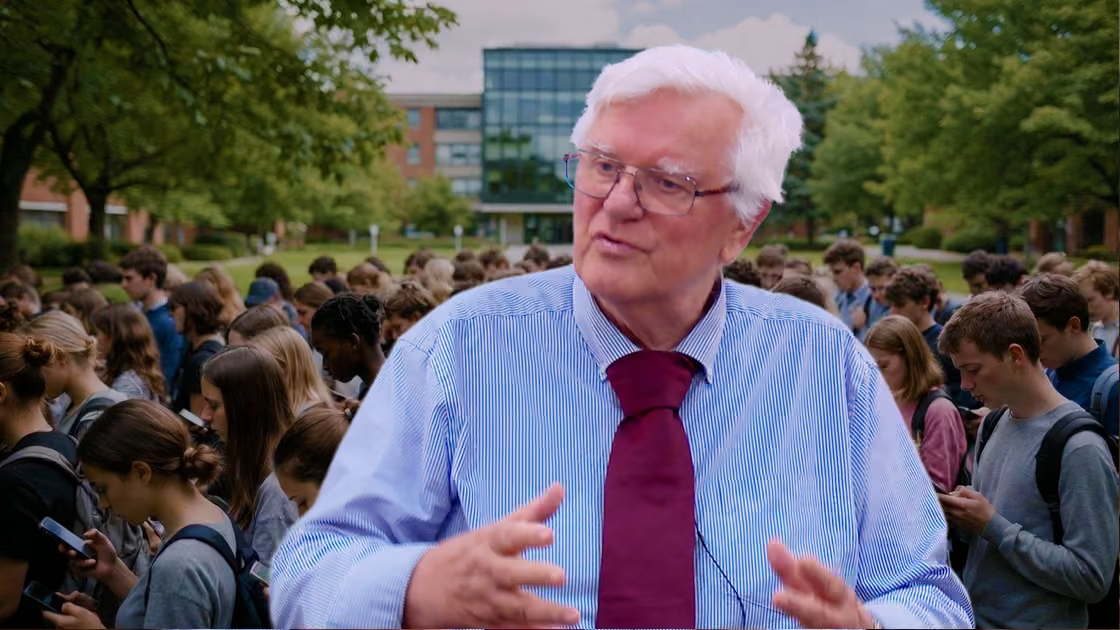
And in my speech, I always said to the students, please do go to the library from time to time the door is open. Pick up a book, read the judgments of the High Court of Australia, read the judgments of the Supreme Court of the United States. Read, I beg you read. And whilst I was saying that the students looked at me rather indifferent, they probably thought I came from a different planet. And some other students were looking at their phone all the time and scrolling on their phone. And of course we know that phones is one of the reasons as to why students can't read anymore. In fact, according to statistics that I have read, they spent about seven hours a day looking at their phone and that amounts to 25 years of their life time that could otherwise be spent on reading and accessing the great works of our civilization. And of course, if you can't read properly, you can't write properly, students sometimes have no understanding of full stops, semi-colons, yes, they have no clue whatsoever. So if you don't read properly, you can't write properly.

And that is a problem, but there is even more. If you don't read and you don't write, then you certainly can't think. And in Australia we obviously need people who are able to think properly. We need critical thinking, but thinking these days is a very dangerous occupation. Some people would say it is akin to domestic terrorism. What we need are people who are conforming to the government priorities and wishes. Governments and university leaders don't want people to think thinking is a dangerous occupation. They want conformity not thinking. When I started out in academia, I was always surprised that universities actually offer units and sometimes even courses in critical thinking, they teach students how to think. I was always amused by it because I thought that if you go to university, you should be able to profit from and contribute to university studies. You should already be a critical thinker, a skill that is acquired in high school.

But obviously that is not the case. But unfortunately it is not critical thinking. They actually teach in the university. They teach you to conform with predetermined policies which the university and the government have got. I'd like to tell you a story about Dr. Chair Andre from the Netherlands. He was an associate professor in the University of Groen and he was an excellent professor who was teaching critical thinking. He was an excellent professor. He became a legend almost because his student evaluations were the best of the whole university. He did not tell students what to think. He told students how to think. He told students to carefully study the data on which they relied to carefully assess the literature on which they relied. And when the students wrote their paper, their essay, he would relentlessly criticise their thinking, their logic, and also the literature on which they relied.

But more importantly, he told the students repeatedly that there is no such thing as a safe learning environment. Universities these days want to have a safe learning environment. That means that you can't say anything that may be considered offensive by the recipient of the message. But a safe learning environment is a contradiction in terms because in a safe learning environment, you learn absolutely nothing. You have to stretch your mind, your mental capacity, and you can't do that in a safe learning environment. You don't learn anything, and that's probably precisely what the university intended to achieve.

So our professor, Inger Anda, was sacked because the university could not possibly control him. The university wants to know exactly what professors teach. They want to know week by week what topic is going to be covered, how you are going to approach the topic and what the result is going to be and what the impact on students is going to be. Obviously, he could not comply with all these bureaucratic requirements and he was sacked even though he was teaching critical thinking. And even though he was one of the best professors, perhaps the best professor in the university. Now I have referred to critical thinking. Now what is critical thinking? That thinking that I believe students should possess if they want to contribute to our society. It is a skill. It is an ability which enables them to assess, examine, evaluate the laws and the policies adopted by our politicians.

But of course that definition is very general. And because it is general, it is possibly meaningless. And therefore I'm going to tell you precisely what critical thinking is according to me. And I will do that by telling you a story. It is the story of the elephant and the rope. Perhaps some of you may have heard the story of the elephant and the rope. It is a story about a circus elephant. And when the circus elephant was born, that is when it was a gulf. It had a rope tied around its front legs apparently that facilitated the work of its minder, especially if the minder wanted to manipulate the animal and train it for circus practises and procedures. Obviously the elephant is a very big animal and a strong animal that could easily have destroyed rope. But interestingly and curiously, the elephant never destroyed the rope and it never destroyed the rope because it had been led to believe that it could not possibly destroy the rope.

It was conditioned into believing that it could not possibly destroy the rope. In other words, the animal had been conditioned in into believing that it could not break free from what happened to it. And here we have the verb that I would like to stress, namely break free critical thinking is the ability to actually break free from government imposed narratives or spontaneously developed narratives. It is the ability to break free and to independently assess and examine and evaluate the value of what is before us. It is the ability to break free from government narratives, from narratives in general to independently assess those narratives.

It is just about breaking free, but there is more. A well-known sociologist from the United States published a book in 1,906. I'm talking about William Sumner and the title of the book is Qua. And he said basically that critical thinking is a skill which enables people to become slow believers. You have to be a slow believer. You will be a slow believer if you do not uncritically accept whatever the government tells you, whatever authority tells you. Of course I know that there's the same message that Marcus also told his students, but of course it was for the achievement of left-wing purposes for me at is for the achievement of what is common sense, right-wing purposes, decency and logic. So basically a critical thinker and students are no longer critical thinkers, are people who are slow believers and they break free from all the impositions, which they have to suffer at the moment.

So that is the first thing that is wrong with universities. Namely people don't read anymore. And in fact, I could even say more, the great classics of Western civilization are actually banned in the university. They will never be discussed. They have been substituted by materials about woke institutions and so on. That is what is happening. It always reminds me of Aldis Huxley who wrote a Brave New World. Aldis Huxley said There is no need to ban books because there will come a time when nobody is going to read anyway. And we have arrived at that point in time where it is no longer necessary to actually ban books because very few people these days actually read. Now, the second point that I wanted to talk about briefly is the abandonment of free speech. There is practically no free speech in universities, and this is because of the obstinate implementation by universities of DEI, diversity, inclusiveness and equity, DEI, which means that whenever you say something that offends the feelings of another person, of a recipient, then you have violated the law.

Of course, we have seen during the last couple of weeks that governments around Australia, including state governments and parliaments and federal parliament have adopted hate speechs laws. Well, I find that rather problematic because what is hate Speechs law for you is probably just free speech to another person. The concept of hate speechs is ultimately an indeterminate category. The meaning of which has to be filled in by policymakers and trendsetters. We will not know what it is, it'll mean what the government and some of the courts will tell you what it means. Hate speech. Of course, until a few years ago, you would only have violated hate speeds if you incited violence. But an intention to incite violence is no longer necessary because the legislator has adopted recklessness test. That means if you make a statement recklessly, even if you do not intend to incite violence, you are deemed to have violated the hate speechs law, which politicians even today want to strengthen even.

So I like to refer to 2018 when the former Chief Justice French was asked by the government of the day to write a free speech code, a free speech code, which universities were expected to adopt. And all the universities in Australia, 42 of them adopted a speech code. However, there are so many exceptions that the speech code is ultimately quite irrelevant. You can't say anything that potentially or actually violates the feelings of any person, including visitors to the university. Free speech has never been one of the priorities of universities. Even in the 1980s, the South African ambassador was not allowed to speak on the campus of a NU because of the fact that he served an apartheid regime. You see, free speech means free speech. Free speech has to flourish because if we don't allow free speech, it'll go underground where it'll fester and fact and the day will come that it'll all explode.

It always reminds me of a statement made by one of the most famous American justices who never became a member of the Supreme Court. His name is Learn Hand. He says, freedom must be in the hearts of people If it is not there. No constitution, no government, no code will protect you beneath free speech because if there is free speech, we are able to respond to it. Free speech should flourish in the marketplace of ideas. That is the world in which we live. That will lead to a vibrant society. The third thing that is wrong with university is that the university is not interested in education anymore. It is an industry.

I have just come back from the university, well, I'm not going to mention the university from a university down south, and I was teaching a course in international business law. I had 101 students in my class. 95 students came from mainland China. And the majority of those students could not really speak English, not even conversationally. That's a problem. But they had the capacity to pay. And I asked my students, how much do you pay for my course? They told me they paid $5,600, only a pittance of which of course is paid to me quite naturally. So it becomes an industry. Of course, the university will claim that it needs more and more international students because it receives fewer funds from the government, which may well be the case, but it comes at the expense of education. And this leads me to my fourth point.

There is no search for excellence anymore in educational institutions. All students are expected to pass in, including the Chinese students that I talked about because although the Chinese students could not speak English, even conversationally, they wrote excellent papers full of logic and impeccable. So I knew they did not write it. It may have been written by AI or by an agency or by somebody else, but certainly the student did not do it. Now, I am not Sherlock Holmes. I'm not going to investigate how it comes that suddenly a student is able to become a perfect writer even though they can't really speak at all. I just read what is in front of me and that is my job. That's the only thing I'm being paid for. But these days you can't really fail students anymore. If you give a student 49, 48 or 47 out of 100, they're supposed to fail.

But the student really never fails because if you give them even 46 or 47, they will almost inevitably appeal, which creates all sorts of problems for the lecturer. They will appeal. And the university has a suite of measures and programmes which enable students to get over the line, deferred examinations and all sorts of privileges, longer periods given for them to complete an exam. All sorts of privileges, a supplementary exam. In the end, you've passed all the exams because if you don't, you the lecturer is going to be in hot water. So my conclusion then is that the university is no longer interested in an academic journey of excellence that is no longer involved in stimulating intellectual discussion in education involving the great ideas of our civilization that has become an industry which however, is not in my opinion and education industry. And therefore, perhaps some of you may well say, well, in that case, if you are right Gabriel, why should we still go to university?

A very good question. Some very competent and influential people never went to university. In fact, decided deliberately, intentionally to avoid the wokeness that now exists in universities. I haven't even spoken about how woke the university is. Every single document, even a one page document, will always contain a welcome to country or acknowledgement of country. I really don't know to what extent that improves the educational experience of the students, but that is clearly a fact. So some people have decided not to go to university, and one good example is Charlie Kirk in the United States, one of the most young promising politicians who unfortunately was assassinated on the 10th of September row, Dean perhaps of Sky News is another one. I still believe that it is worthwhile to go to university to get even a distorted education as long as there is the ability and the willingness to be an independent thinker, to become a critical thinker.

That is the key message that I therefore have got for you. And perhaps I should end by reminding you of the real function of a university. The real function of the university was discussed by many people, including, for example, Cardinal John Henry Newman in 1850. In his celebrated book, the Idea of a University, he said, A university is a place where the intellect is educated. It is about the education of the intellect. And about 100 years ago, Carl Jasper in Europe said that he fully agreed with John Henry Newman, but he added that the imaginative impartation of knowledge should also be the function of the university. And there will only be an imaginative impartation of knowledge if people are willing to talk to each other where there is free speech and free inquiry. That is what we need to happen in universities. And to conclude, I would like to read poem, a poem that one of my friends wrote, namely John Mac Robert.

I write opinion pieces with him about climate change. He is also very, unfortunately, a very old white, pale man, even older than I am, most despicable, of course, but he still writes with me, and he is also a poet, and he writes under the name John mc poet. And this poem is from Ska 2000, and it is about rivers of life. It's a very short poem, and I would end my conversation with this poem. Here it is. There are two mighty rivers. One is hope and one despair. And those travellers on the ladder are not going anywhere. Despair is slow and sluggish. A sad journey to what End River. Hope flows fast and freely with a new view around every bend. Let's hope that the future belongs to us.

Thank you very much.

What is wrong with the universities today
Watch the video


TRANSCRIPT: 

(This transcript is derived from an automated process.  The video recording is authoritative.)  

Professor Gabriël Moens:

Well, good evening to all of you. I would like to thank you, Mrs Burbidge, for your very informative discussion of the great march through the institutions. And of course, I would also like to say that you reminded me of the fact that I'm an old white, pale man. That being said to, I still have a lot to offer.

When I came to Australia, I was 27 years of age and since then I have been working in the academia for 50 years. Not just in Australia, but also in Europe and in the United States. But during that time I also worked for a time for SBS, for the diplomatic service for law firms, and I did many other things as well, including working for Chambers of Commerce. So I have a little bit of knowledge of the march through the institutions, but tonight of course I would mainly like to talk about universities because that is the place I know best.

And I'm going to tell you precisely what is wrong with universities today. Now, the first thing that is wrong with universities is the fact that universities these days admit many students who can't read properly. Yes, I would say that a very substantial minority, perhaps even a majority of students, can't read properly. And that is a major problem because they can't read the great works of western civilization. The great works of western civilization contain the wisdom of civilization, and they are unable to access this wisdom because they can't read properly. I'm sure that many students would have never read a novel. They certainly would not be able to read a philosophical work or a theological work or even a historical work because they can't read. When I was dean of law in Western Australia, I always spoke to the students on their first day to welcome the students to the law school.

And in my speech, I always said to the students, please do go to the library from time to time the door is open. Pick up a book, read the judgments of the High Court of Australia, read the judgments of the Supreme Court of the United States. Read, I beg you read. And whilst I was saying that the students looked at me rather indifferent, they probably thought I came from a different planet. And some other students were looking at their phone all the time and scrolling on their phone. And of course we know that phones is one of the reasons as to why students can't read anymore. In fact, according to statistics that I have read, they spent about seven hours a day looking at their phone and that amounts to 25 years of their life time that could otherwise be spent on reading and accessing the great works of our civilization. And of course, if you can't read properly, you can't write properly, students sometimes have no understanding of full stops, semi-colons, yes, they have no clue whatsoever. So if you don't read properly, you can't write properly.

And that is a problem, but there is even more. If you don't read and you don't write, then you certainly can't think. And in Australia we obviously need people who are able to think properly. We need critical thinking, but thinking these days is a very dangerous occupation. Some people would say it is akin to domestic terrorism. What we need are people who are conforming to the government priorities and wishes. Governments and university leaders don't want people to think thinking is a dangerous occupation. They want conformity not thinking. When I started out in academia, I was always surprised that universities actually offer units and sometimes even courses in critical thinking, they teach students how to think. I was always amused by it because I thought that if you go to university, you should be able to profit from and contribute to university studies. You should already be a critical thinker, a skill that is acquired in high school.

But obviously that is not the case. But unfortunately it is not critical thinking. They actually teach in the university. They teach you to conform with predetermined policies which the university and the government have got. I'd like to tell you a story about Dr. Chair Andre from the Netherlands. He was an associate professor in the University of Groen and he was an excellent professor who was teaching critical thinking. He was an excellent professor. He became a legend almost because his student evaluations were the best of the whole university. He did not tell students what to think. He told students how to think. He told students to carefully study the data on which they relied to carefully assess the literature on which they relied. And when the students wrote their paper, their essay, he would relentlessly criticise their thinking, their logic, and also the literature on which they relied.

But more importantly, he told the students repeatedly that there is no such thing as a safe learning environment. Universities these days want to have a safe learning environment. That means that you can't say anything that may be considered offensive by the recipient of the message. But a safe learning environment is a contradiction in terms because in a safe learning environment, you learn absolutely nothing. You have to stretch your mind, your mental capacity, and you can't do that in a safe learning environment. You don't learn anything, and that's probably precisely what the university intended to achieve.

So our professor, Inger Anda, was sacked because the university could not possibly control him. The university wants to know exactly what professors teach. They want to know week by week what topic is going to be covered, how you are going to approach the topic and what the result is going to be and what the impact on students is going to be. Obviously, he could not comply with all these bureaucratic requirements and he was sacked even though he was teaching critical thinking. And even though he was one of the best professors, perhaps the best professor in the university. Now I have referred to critical thinking. Now what is critical thinking? That thinking that I believe students should possess if they want to contribute to our society. It is a skill. It is an ability which enables them to assess, examine, evaluate the laws and the policies adopted by our politicians.

But of course that definition is very general. And because it is general, it is possibly meaningless. And therefore I'm going to tell you precisely what critical thinking is according to me. And I will do that by telling you a story. It is the story of the elephant and the rope. Perhaps some of you may have heard the story of the elephant and the rope. It is a story about a circus elephant. And when the circus elephant was born, that is when it was a gulf. It had a rope tied around its front legs apparently that facilitated the work of its minder, especially if the minder wanted to manipulate the animal and train it for circus practises and procedures. Obviously the elephant is a very big animal and a strong animal that could easily have destroyed rope. But interestingly and curiously, the elephant never destroyed the rope and it never destroyed the rope because it had been led to believe that it could not possibly destroy the rope.

It was conditioned into believing that it could not possibly destroy the rope. In other words, the animal had been conditioned in into believing that it could not break free from what happened to it. And here we have the verb that I would like to stress, namely break free critical thinking is the ability to actually break free from government imposed narratives or spontaneously developed narratives. It is the ability to break free and to independently assess and examine and evaluate the value of what is before us. It is the ability to break free from government narratives, from narratives in general to independently assess those narratives.

It is just about breaking free, but there is more. A well-known sociologist from the United States published a book in 1,906. I'm talking about William Sumner and the title of the book is Qua. And he said basically that critical thinking is a skill which enables people to become slow believers. You have to be a slow believer. You will be a slow believer if you do not uncritically accept whatever the government tells you, whatever authority tells you. Of course I know that there's the same message that Marcus also told his students, but of course it was for the achievement of left-wing purposes for me at is for the achievement of what is common sense, right-wing purposes, decency and logic. So basically a critical thinker and students are no longer critical thinkers, are people who are slow believers and they break free from all the impositions, which they have to suffer at the moment.

So that is the first thing that is wrong with universities. Namely people don't read anymore. And in fact, I could even say more, the great classics of Western civilization are actually banned in the university. They will never be discussed. They have been substituted by materials about woke institutions and so on. That is what is happening. It always reminds me of Aldis Huxley who wrote a Brave New World. Aldis Huxley said There is no need to ban books because there will come a time when nobody is going to read anyway. And we have arrived at that point in time where it is no longer necessary to actually ban books because very few people these days actually read. Now, the second point that I wanted to talk about briefly is the abandonment of free speech. There is practically no free speech in universities, and this is because of the obstinate implementation by universities of DEI, diversity, inclusiveness and equity, DEI, which means that whenever you say something that offends the feelings of another person, of a recipient, then you have violated the law.

Of course, we have seen during the last couple of weeks that governments around Australia, including state governments and parliaments and federal parliament have adopted hate speechs laws. Well, I find that rather problematic because what is hate Speechs law for you is probably just free speech to another person. The concept of hate speechs is ultimately an indeterminate category. The meaning of which has to be filled in by policymakers and trendsetters. We will not know what it is, it'll mean what the government and some of the courts will tell you what it means. Hate speech. Of course, until a few years ago, you would only have violated hate speeds if you incited violence. But an intention to incite violence is no longer necessary because the legislator has adopted recklessness test. That means if you make a statement recklessly, even if you do not intend to incite violence, you are deemed to have violated the hate speechs law, which politicians even today want to strengthen even.

So I like to refer to 2018 when the former Chief Justice French was asked by the government of the day to write a free speech code, a free speech code, which universities were expected to adopt. And all the universities in Australia, 42 of them adopted a speech code. However, there are so many exceptions that the speech code is ultimately quite irrelevant. You can't say anything that potentially or actually violates the feelings of any person, including visitors to the university. Free speech has never been one of the priorities of universities. Even in the 1980s, the South African ambassador was not allowed to speak on the campus of a NU because of the fact that he served an apartheid regime. You see, free speech means free speech. Free speech has to flourish because if we don't allow free speech, it'll go underground where it'll fester and fact and the day will come that it'll all explode.

It always reminds me of a statement made by one of the most famous American justices who never became a member of the Supreme Court. His name is Learn Hand. He says, freedom must be in the hearts of people If it is not there. No constitution, no government, no code will protect you beneath free speech because if there is free speech, we are able to respond to it. Free speech should flourish in the marketplace of ideas. That is the world in which we live. That will lead to a vibrant society. The third thing that is wrong with university is that the university is not interested in education anymore. It is an industry.

I have just come back from the university, well, I'm not going to mention the university from a university down south, and I was teaching a course in international business law. I had 101 students in my class. 95 students came from mainland China. And the majority of those students could not really speak English, not even conversationally. That's a problem. But they had the capacity to pay. And I asked my students, how much do you pay for my course? They told me they paid $5,600, only a pittance of which of course is paid to me quite naturally. So it becomes an industry. Of course, the university will claim that it needs more and more international students because it receives fewer funds from the government, which may well be the case, but it comes at the expense of education. And this leads me to my fourth point.

There is no search for excellence anymore in educational institutions. All students are expected to pass in, including the Chinese students that I talked about because although the Chinese students could not speak English, even conversationally, they wrote excellent papers full of logic and impeccable. So I knew they did not write it. It may have been written by AI or by an agency or by somebody else, but certainly the student did not do it. Now, I am not Sherlock Holmes. I'm not going to investigate how it comes that suddenly a student is able to become a perfect writer even though they can't really speak at all. I just read what is in front of me and that is my job. That's the only thing I'm being paid for. But these days you can't really fail students anymore. If you give a student 49, 48 or 47 out of 100, they're supposed to fail.

But the student really never fails because if you give them even 46 or 47, they will almost inevitably appeal, which creates all sorts of problems for the lecturer. They will appeal. And the university has a suite of measures and programmes which enable students to get over the line, deferred examinations and all sorts of privileges, longer periods given for them to complete an exam. All sorts of privileges, a supplementary exam. In the end, you've passed all the exams because if you don't, you the lecturer is going to be in hot water. So my conclusion then is that the university is no longer interested in an academic journey of excellence that is no longer involved in stimulating intellectual discussion in education involving the great ideas of our civilization that has become an industry which however, is not in my opinion and education industry. And therefore, perhaps some of you may well say, well, in that case, if you are right Gabriel, why should we still go to university?

A very good question. Some very competent and influential people never went to university. In fact, decided deliberately, intentionally to avoid the wokeness that now exists in universities. I haven't even spoken about how woke the university is. Every single document, even a one page document, will always contain a welcome to country or acknowledgement of country. I really don't know to what extent that improves the educational experience of the students, but that is clearly a fact. So some people have decided not to go to university, and one good example is Charlie Kirk in the United States, one of the most young promising politicians who unfortunately was assassinated on the 10th of September row, Dean perhaps of Sky News is another one. I still believe that it is worthwhile to go to university to get even a distorted education as long as there is the ability and the willingness to be an independent thinker, to become a critical thinker.

That is the key message that I therefore have got for you. And perhaps I should end by reminding you of the real function of a university. The real function of the university was discussed by many people, including, for example, Cardinal John Henry Newman in 1850. In his celebrated book, the Idea of a University, he said, A university is a place where the intellect is educated. It is about the education of the intellect. And about 100 years ago, Carl Jasper in Europe said that he fully agreed with John Henry Newman, but he added that the imaginative impartation of knowledge should also be the function of the university. And there will only be an imaginative impartation of knowledge if people are willing to talk to each other where there is free speech and free inquiry. That is what we need to happen in universities. And to conclude, I would like to read poem, a poem that one of my friends wrote, namely John Mac Robert.

I write opinion pieces with him about climate change. He is also very, unfortunately, a very old white, pale man, even older than I am, most despicable, of course, but he still writes with me, and he is also a poet, and he writes under the name John mc poet. And this poem is from Ska 2000, and it is about rivers of life. It's a very short poem, and I would end my conversation with this poem. Here it is. There are two mighty rivers. One is hope and one despair. And those travellers on the ladder are not going anywhere. Despair is slow and sluggish. A sad journey to what End River. Hope flows fast and freely with a new view around every bend. Let's hope that the future belongs to us.

Thank you very much.